

Population Pressure: Finding Sustainable Answers to India’s Silent Surge
India stands at a defining demographic moment. Having overtaken China as the world’s most populous nation, the country’s population story is no longer just about numbers—it is about sustainability, opportunity, and balance. The question is not merely how many people India has, but how effectively it can provide for them.
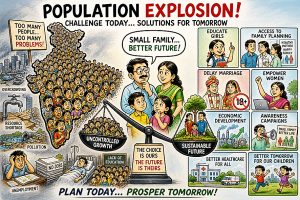
Population Pressure: Finding Sustainable Answers to India’s Silent Surge.
The Expanding Challenge
Rapid population growth places immense pressure on urban infrastructure, natural resources, healthcare, education, and employment. Cities like Mumbai and Delhi already grapple with overcrowding, housing shortages, traffic congestion, and strained civic amenities.
At the same time, a growing population brings potential—a larger workforce, a broader consumer base, and demographic energy. The challenge lies in managing this growth wisely.
Understanding the Root Causes
Population expansion is not accidental; it is shaped by social, economic, and cultural factors:
- Limited access to family planning services in certain regions
- Early marriages and low awareness about reproductive health
- Preference for larger families in some communities
- Economic insecurity, where more children are seen as future support
- Gaps in female education and workforce participation
Addressing population growth requires tackling these underlying issues, not just the numbers.
Ways and Means to Address Population Explosion
1. Empowering Women Through Education
Education remains the most effective tool for population control. Studies consistently show that educated women tend to marry later, have fewer children, and make informed choices about family planning. Expanding access to quality education for girls can have a transformative, long-term impact.
2. Strengthening Healthcare and Family Planning
Accessible and affordable reproductive healthcare is essential. Government initiatives promoting contraception, maternal care, and awareness must be expanded, especially in rural and underserved areas. Ensuring dignity and choice in family planning is key.
3. Promoting Economic Security
When families feel financially secure, the perceived need for larger families declines. Job creation, social security measures, and rural development programs can help shift this mindset.
4. Delaying Age of Marriage
Encouraging later marriages through awareness campaigns and strict enforcement of legal age norms can significantly reduce population growth rates. Delayed parenthood often leads to smaller, healthier families.
5. Urban Planning and Migration Management
Better urban planning can reduce the strain on mega-cities. Developing smaller towns and regional hubs can distribute population density more evenly and create balanced growth.
6. Public Awareness Campaigns
Sustained awareness efforts are crucial. Campaigns that promote the idea of “small family, better future” must evolve to reflect modern aspirations—focusing on quality of life rather than mere survival.
7. Leveraging Technology and Data
Digital health platforms, data-driven governance, and targeted interventions can improve the efficiency of population control programs. Technology can help identify high-growth areas and tailor solutions accordingly.
A Shift in Perspective
India’s population challenge is not just about control—it is about management and optimisation. The focus must shift from fear of numbers to investment in human capital.
Countries that have successfully stabilised population growth have done so not through coercion, but through education, empowerment, and economic progress.
Conclusion
Population explosion is often framed as a crisis, but it can also be an opportunity—if managed with foresight. The path forward lies in balancing growth with sustainability, ensuring that every citizen has access to resources, opportunities, and a decent quality of life.
The real question is not how to reduce numbers overnight, but how to build a future where numbers no longer feel like a burden.