

The Invisible Luxury: A Fragrant Journey Through Time
Before the first word was written, before the first coin was minted, there was fragrance. Invisible yet powerful, scent has travelled with humanity through rituals, romance, royalty, and revolution. It is perhaps the most intimate of all luxuries—worn, not seen; remembered, not recorded.
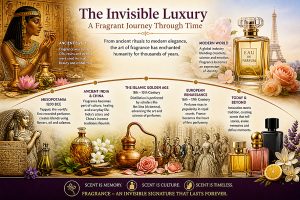
A fragrant journey through time.
Where It All Began
The story of fragrance begins in the ancient civilizations of Mesopotamia and Egypt, where aromatic resins, oils, and herbs were burned in religious ceremonies. The word “perfume” itself is derived from the Latin per fumum, meaning “through smoke.”
In ancient Egypt, fragrance was not merely cosmetic—it was sacred. Priests used scented oils in temples, while royalty adorned themselves with elaborate perfumes made from myrrh, frankincense, and lotus. Even in death, scent remained significant; embalming rituals relied heavily on aromatic substances.
The First Perfumer
History credits Tapputi, a chemist from Mesopotamia around 1200 BCE, as the world’s first recorded perfumer. She used flowers, oil, and calamus, employing techniques like distillation and filtration—methods still relevant in modern perfumery.
The Spread of Scent
From the Middle East, the art of fragrance travelled to India and China, where it blended with local traditions. In India, the tradition of attar—natural perfume derived from flowers like rose and jasmine—became deeply embedded in culture, particularly during the Mughal era.
The refinement of distillation techniques by the Persian polymath Ibn Sina revolutionised perfumery. His method of extracting essential oils, especially from roses, marked a turning point in the science of fragrance.
Europe and the Rise of Perfume Culture
Perfume reached new heights in Europe during the Renaissance. By the 17th century, France had emerged as the global hub of perfumery, particularly in the town of Grasse.
Initially used to mask unpleasant odours in an era of limited hygiene, perfumes soon became symbols of status and sophistication. The courts of Louis XIV were famously obsessed with scent, earning him the nickname “the perfumed court.”
Fragrance in the Modern World
Today, the fragrance industry is a multi-billion-dollar global enterprise, blending chemistry, artistry, and branding. From luxury labels to niche artisanal creations, perfumes have become extensions of identity.
Yet, despite technological advances, the essence of perfumery remains unchanged: capturing fleeting moments—rain on earth, blooming flowers, ocean air—and preserving them in a bottle.
The Psychology of Scent
Fragrance is deeply tied to memory and emotion. A single scent can transport us across time—back to childhood, to a loved one, or to a place long forgotten. Scientists attribute this to the olfactory system’s close connection with the brain’s limbic system, which governs memory and emotion.
This is why perfumes are often described not just as products, but as experiences.
India’s Enduring Legacy
India continues to hold a unique place in the world of fragrance. Cities like Kannauj, often called the “perfume capital of India,” keep alive centuries-old traditions of natural attar-making. In a world leaning towards synthetic blends, this heritage stands as a reminder of authenticity and craftsmanship.
Conclusion
Fragrance is more than a sensory indulgence—it is a bridge between past and present, science and art, memory and identity. From sacred rituals in ancient temples to modern-day luxury boutiques, the journey of scent mirrors the journey of civilization itself.
In the end, while trends may change and bottles may evolve, the allure of fragrance remains timeless—an invisible signature that speaks long after we have left the room.