

Global Commodity Markets on Edge: Oil Surges, Metals Steady, Food Prices Face Climate Risk
Mumbai: The global commodity market is entering a volatile phase as geopolitical tensions, climate uncertainty, and shifting demand patterns create a perfect storm across key sectors. From crude oil spikes to resilient metals and fragile food supply chains, commodities are once again at the center of the global economic narrative.
Crude oil remains the biggest driver of market sentiment. Prices have surged sharply in recent weeks amid ongoing tensions in West Asia, raising fears of supply disruptions. For India, one of the world’s largest oil importers, the impact is immediate—higher import bills, pressure on inflation, and potential ripple effects across transport and manufacturing sectors.
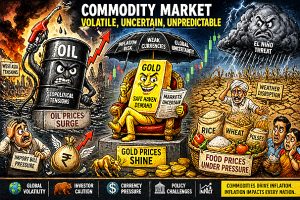
Global Commodity Markets on Edge: Oil Surges, Metals Steady, Food Prices Face Climate Risk.
In contrast, industrial metals are showing relative stability. Copper and aluminum prices have held firm, supported by steady demand from infrastructure projects and energy transition investments. Analysts suggest that the global push toward electrification and renewable energy continues to underpin long-term demand for these metals, even as short-term volatility persists.
Gold, traditionally a safe-haven asset, is witnessing renewed investor interest. With uncertainty dominating global markets and currencies showing signs of weakness, investors are increasingly turning to gold as a hedge against inflation and geopolitical risk. The trend is particularly visible in emerging markets, where retail demand has also seen an uptick.
However, the most concerning signals are emerging from agricultural commodities. Weather disruptions linked to a potential El Niño event are raising alarms about crop yields across Asia and beyond. A weaker monsoon in India could affect production of staples such as rice, wheat, and pulses—potentially driving food inflation higher in the coming months.
Back home, the commodity story is closely tied to domestic policy and demand cycles. The government’s infrastructure push continues to support demand for steel, cement, and energy resources, while efforts to boost domestic production in sectors like coal and critical minerals are aimed at reducing import dependence.
At the same time, global investors are becoming increasingly cautious. Volatility in commodity prices often translates into uncertainty in equity and currency markets, and recent movements suggest a shift toward risk aversion. This could impact capital flows into emerging economies, including India.
The broader takeaway is clear: commodities are no longer just a supporting factor—they are driving the narrative.
Whether it is oil influencing inflation, metals shaping industrial growth, or food prices affecting household budgets, the commodity market is deeply intertwined with economic stability. As global uncertainties persist, the coming months are likely to see continued volatility, making commodities a key space to watch for policymakers, businesses, and investors alike.
In a world grappling with geopolitical shifts and climate challenges, the commodity cycle is not just fluctuating—it is redefining the rules of economic engagement.
www.forevernews.in