



India’s Paint Industry Faces a New Coat of Competition Amid Slower Growth
India’s paints and coatings industry, long considered a steady compounder in the consumption space, is entering a new phase marked by intense competition, margin pressures, and evolving consumer demand. Even as the sector retains its long-term growth appeal, recent trends suggest a more complex landscape for both incumbents and new entrants.
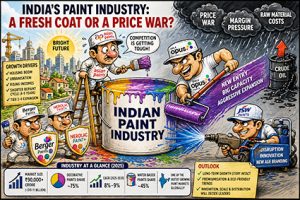
India’s Paint Industry Faces a New Coat of Competition Amid Slower Growth.
The domestic paint market is currently valued at over ₹90,000 crore (around $10–11 billion) and is projected to grow to nearly ₹1.4–1.5 lakh crore by the end of the decade. With an expected CAGR of 8–9%, India continues to be among the fastest-growing paint markets globally, driven by rising urbanisation, infrastructure spending, and increasing disposable incomes.
A key structural driver remains the dominance of the decorative segment, which accounts for nearly 75% of the market. Demand is closely linked to housing cycles, renovation trends, and festive seasons. Notably, the repainting cycle in India has shortened from 7–8 years to about 4–5 years, boosting recurring demand. Additionally, deeper penetration into Tier 2, Tier 3, and rural markets is expanding the consumer base beyond metropolitan cities.
However, the industry is no longer the high-margin haven it once was.
Market leader Asian Paints continues to hold a dominant position, but competition has intensified significantly. Established players like Berger Paints, Kansai Nerolac, and Akzo Nobel India are now facing aggressive expansion from newer entrants such as JSW Paints and the Aditya Birla Group’s Birla Opus.
The entry of Birla Opus, in particular, has altered the competitive dynamics. Backed by significant capital investment and large-scale manufacturing capacity, the brand has quickly emerged as a formidable challenger, triggering pricing pressures across the sector. Industry experts note that the market is shifting from a relatively consolidated structure to a more fragmented and competitive one.
Adding to the pressure are rising input costs. Paint manufacturers rely heavily on crude oil derivatives, making them vulnerable to global commodity fluctuations. While raw material prices have shown some moderation recently, volatility remains a concern. At the same time, companies are increasingly investing in branding, dealer incentives, and distribution expansion, further impacting margins.
Volume growth, too, has shown signs of moderation. Estimates suggest that industry growth may slow to around 4–5% in the near term, largely due to subdued urban demand and uneven monsoon patterns affecting rural consumption. This marks a departure from the double-digit growth seen in earlier years.
Yet, the industry is far from losing its sheen.
Emerging trends indicate a shift towards premiumisation and sustainability. Consumers are increasingly opting for eco-friendly, low-VOC (volatile organic compound) paints, along with value-added products such as anti-bacterial, weather-resistant, and heat-reflective coatings. Water-based paints are gaining traction, supported by both regulatory push and consumer awareness.
Technology is also playing a larger role, with companies leveraging digital tools for colour selection, virtual painting simulations, and dealer network optimisation.
Way ahead for the paint industry
Looking ahead, the Indian paint industry is expected to remain a strong long-term play, supported by low per capita consumption compared to global standards and sustained demand from housing and infrastructure sectors. However, the next phase of growth will likely be defined less by easy expansion and more by strategic execution.
As competition heats up and margins tighten, success will depend on scale, innovation, and distribution strength—marking a clear shift from the industry’s earlier, more predictable trajectory.
In essence, India’s paint sector is not fading—it’s being repainted with sharper competition and smarter strategies.
By Forever News Desk
