



India’s Gold Appetite Sparks Import Surge, Raises Economic Concerns
Switzerland Emerges as India’s Biggest Gold Supplier as Imports Jump 24% in FY26
Mumbai: India’s enduring love for gold is once again shining brightly in global trade data, but behind the glitter lies a growing concern for policymakers and economists alike.
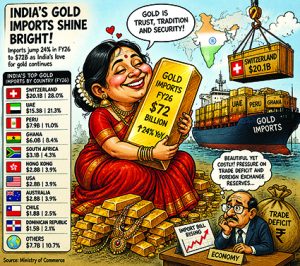
India’s Gold Appetite Sparks Import Surge, Raises Economic Concerns.
According to the latest Ministry of Commerce data for FY26, India imported nearly $72 billion worth of gold, marking a sharp 24% year-on-year increase. The surge reflects robust domestic demand for jewellery, investment-driven buying, festive consumption, and a continued preference for gold as a safe-haven asset amid global uncertainty.
The data also reveals an interesting global sourcing pattern, with Switzerland emerging as India’s largest gold import partner.
Switzerland Tops India’s Gold Import List
India imported approximately $20.1 billion worth of gold from Switzerland during FY26, accounting for nearly 28% of total gold imports. The European nation continues to dominate India’s bullion supply chain due to its globally established refining and trading ecosystem.
The United Arab Emirates (UAE) followed closely with $15.3 billion worth of exports to India, contributing over 21% of total imports. Peru stood third with $7.9 billion, while Ghana supplied gold worth around $6 billion.
Other significant contributors included South Africa, Hong Kong, the United States, Australia, Chile, and the Dominican Republic.
Industry experts say India’s sourcing diversification reflects changing global bullion routes, refining capacities, trade agreements, and pricing advantages.
Why Indians Continue Buying Gold
Despite record-high gold prices globally, Indian demand has remained resilient.
Analysts attribute this trend to multiple factors:
- Gold’s traditional role in Indian households as a store of wealth
- Wedding and festive season demand
- Rising geopolitical tensions driving safe-haven investments
- Inflation concerns impacting savings behaviour
- Increasing retail investment through digital gold and ETFs
For millions of Indian families, gold continues to represent financial security, cultural prestige, and emergency liquidity.
Rural India, in particular, remains heavily dependent on gold as an informal savings instrument.
Economic Impact Raises Concerns
While strong gold imports indicate healthy consumer demand, they also place pressure on India’s trade deficit and foreign exchange outflows.
Gold, unlike industrial imports, does not directly contribute to productive economic capacity. Economists often view excessive bullion imports as a strain on the current account balance because they increase dollar outflows without proportionate export generation.
With crude oil prices already influencing India’s import bill, rising gold imports could complicate macroeconomic management if the trend continues.
The Reserve Bank of India and policymakers have historically attempted to moderate gold imports through import duties, sovereign gold bonds, and financial investment alternatives aimed at reducing physical gold dependency.
However, consumer behaviour has proven difficult to alter.
Shift in Global Supply Dynamics
The dominance of Switzerland reflects the country’s role as one of the world’s largest gold refining hubs. Much of the gold refined there originates from mining economies across Africa and Latin America before being re-exported globally.
Meanwhile, the UAE’s growing role highlights Dubai’s emergence as a critical bullion trading gateway for India due to logistics advantages and strong trade connectivity.
Peru and Ghana’s increasing contribution also points toward India’s expanding engagement with mining economies outside traditional supply corridors.
Safe Haven in Uncertain Times
Market observers believe global uncertainty has further strengthened gold’s appeal.
Ongoing geopolitical conflicts, fears of global slowdown, currency volatility, and financial market fluctuations have encouraged investors worldwide to increase exposure to precious metals.
Indian consumers appear to be following the same trend.
“Gold continues to be viewed not merely as jewellery but as financial protection,” said a bullion market analyst. “Whenever uncertainty rises, Indian households traditionally increase gold accumulation.”
The Policy Dilemma
The challenge before policymakers remains balancing consumer sentiment with macroeconomic stability.
India’s policymakers have repeatedly encouraged investors to move towards financial assets instead of physical gold. Yet the emotional and cultural connection with gold remains deeply embedded across generations.
As India’s economy expands and disposable incomes rise, gold demand is expected to remain structurally strong.
The question now is whether rising imports can be balanced with stronger exports, improved domestic manufacturing, and greater financialisation of savings.
For now, India’s gold story continues to reflect both prosperity and vulnerability — a symbol of wealth that simultaneously tests the country’s economic balancing act.
— Forever News
