



After the Shock: Maharashtra Rewrites Power in the Post–Ajit Pawar Era
Maharashtra’s political theatre has entered a rare and defining moment—one where tragedy has collided with power, and continuity has been forced to emerge from disruption. The sudden death of Ajit Pawar did not just remove a key leader from the state’s ruling architecture; it unsettled a finely balanced system that relied heavily on his administrative grip and political agility. In the days that followed, the swearing-in of Sunetra Pawar as Deputy Chief Minister signalled both urgency and intent: the system would not be allowed to drift.
Yet beneath this swift transition lies a deeper, more complex story—one that is less about succession and more about whether authority, influence, and governance capacity can be transferred as seamlessly as a title.
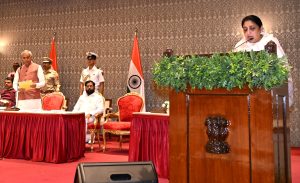
Sunetra Ajit Pawar taking oath as the Deputy Chief Minister of the Maharashtra state.
Ajit Pawar was not merely a political figure; he was, in many ways, the operational engine of governance. Known for his command over the state’s finances and his ability to push decisions through bureaucratic layers, he represented a rare blend of political pragmatism and administrative execution. His absence has created a vacuum that cannot be filled overnight, no matter how decisive the political response appears on the surface.
For Chief Minister Eknath Shinde and Deputy Chief Minister Devendra Fadnavis, the transition has required a recalibration of roles within an already delicate coalition. The alliance—stitched together through political realignments rather than ideological coherence—now faces a new internal equation. Ajit Pawar had functioned as a crucial bridge between the coalition’s moving parts, and without him, the balance of influence is subtly but unmistakably shifting.
In this evolving dynamic, Devendra Fadnavis is expected to assume greater strategic weight, particularly in governance and policy direction. Eknath Shinde, meanwhile, must navigate the more difficult task of preserving equilibrium among allies while projecting stability to the public. The entry of Sunetra Pawar into this structure adds both continuity and uncertainty—continuity in terms of political lineage and party cohesion, but uncertainty in terms of administrative authority and independent decision-making.
Within the Nationalist Congress Party faction, her elevation is as much about consolidation as it is about survival. The Pawar name carries significant influence, particularly in western Maharashtra, where networks of cooperatives, local institutions, and political loyalties have long defined the region’s economic and electoral landscape. By stepping into the role, Sunetra Pawar inherits not just a political office, but an entire ecosystem of influence that will test her ability to lead beyond symbolism.
The opposition, led by figures such as Uddhav Thackeray and Sharad Pawar, is watching closely. For them, this is not a moment for immediate confrontation, but for strategic patience. The narrative they are likely to build will revolve around experience, legitimacy, and governance capability—questions that inevitably arise when leadership transitions occur under extraordinary circumstances. If the ruling alliance falters even slightly in execution, the opposition will be ready to amplify those cracks.
Beyond politics, the implications extend into Maharashtra’s economic landscape. As India’s most industrialised state, contributing a significant share to the national GDP, Maharashtra’s stability is closely watched by investors, businesses, and financial institutions. Ajit Pawar’s reputation for swift decision-making and fiscal control had created a sense of predictability in governance. His absence introduces an element of caution—not panic, but a pause.
Infrastructure projects continue to move, and there is no immediate disruption to ongoing investments. However, economic momentum depends as much on perception as on policy. Investors will be watching how quickly the new leadership establishes command over key portfolios, particularly finance, and whether the pace of approvals and execution remains intact. Even a marginal slowdown in decision-making could ripple through sectors that rely on state clearances and policy support.
Fiscal management emerges as a critical pressure point. Maharashtra’s balancing act between ambitious infrastructure spending and social commitments requires a steady hand. The coming months will reveal whether the administration can maintain financial discipline while navigating a politically sensitive transition.
At the ground level, especially in the cooperative-driven economy of western Maharashtra, the shift carries additional weight. These networks—spanning sugar, banking, and rural industry—have long been intertwined with political leadership. Sunetra Pawar’s ability to retain their confidence will not only influence political stability but also determine the continuity of regional economic structures.
For now, the state holds steady, projecting resilience in the face of sudden change. But stability, in this context, is not a fixed state—it is a process that must be constantly reinforced through governance, decision-making, and public confidence.
The transition from Ajit Pawar to Sunetra Pawar is, therefore, more than a personal or political moment. It is a test of Maharashtra’s institutional strength—of whether its systems can absorb shock without losing momentum. The coming months will define whether this episode is remembered as a seamless continuation of power or as the beginning of a deeper political and administrative shift.
In Maharashtra today, the immediate crisis may have been managed, but the real story is only just beginning to unfold.
www.forevernews.in
