



GIFT City: India’s Financial Powerhouse Gains Momentum Amid Global Shifts
In the quiet expanse along the Sabarmati river, GIFT City is no longer just an ambitious experiment—it is steadily transforming into India’s most strategic financial gateway to the world. What began as a vision to rival global hubs like Singapore and Dubai is now entering a decisive phase where policy, capital, and geopolitics are converging to accelerate its rise.
Over the past year, GIFT City has witnessed a surge in activity that signals both confidence and consolidation. Fund commitments have expanded sharply in recent years, reflecting the rapid scaling of its financial ecosystem. This growth is not accidental; it is the result of a deliberate push to position the city as India’s answer to offshore financial centres.
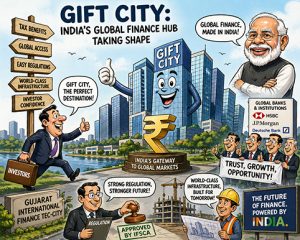
GIFT City Emerges as India’s Global Financial Hub Amid Policy Push and Rising Investments.
The government has reinforced this ambition through policy muscle. Tax incentives, extended operational benefits, and regulatory flexibility have significantly enhanced GIFT City’s global competitiveness, offering long-term certainty to investors. This aligns with a broader national strategy—to bring high-value financial activity back within India’s regulatory framework.
But beyond tax incentives, the real story lies in institutional deepening.
Banking activity within the International Financial Services Centre (IFSC) has grown rapidly, with global financial institutions establishing a presence. Simultaneously, the insurance and reinsurance segments are expanding, indicating a maturing ecosystem capable of handling complex financial products and cross-border risk.
This layered growth is now attracting a different class of participants. Global corporations are increasingly exploring GIFT City as a base for treasury operations—managing cash flows, hedging risks, and funding international activities from within India. The shift is subtle but significant: it positions GIFT City not merely as a services hub, but as a strategic control centre for global capital flows.
Recent regulatory developments further reinforce this trajectory. New frameworks are enabling Indian investors to access international markets through GIFT City, marking a structural shift in capital market participation. At the same time, regulators are tightening compliance norms, signalling a commitment to transparency and global standards.
Leadership and institutional strengthening are also adding momentum. The involvement of industry veterans and the entry of leading legal and advisory firms are helping shape GIFT City into a full-service financial ecosystem capable of supporting global-scale operations.
Yet, the journey is not without friction.
One of the key challenges is talent availability. While infrastructure is world-class, firms are facing difficulties in hiring specialised financial professionals. This gap between infrastructure readiness and human capital could influence the pace of future growth if not addressed proactively.
There is also the question of sustainability. While capital inflows are rising, the long-term success of GIFT City will depend on its ability to anchor consistent global financial activity rather than episodic investment driven by policy incentives.
Still, the direction is unmistakable.
GIFT City today represents a convergence of India’s economic ambition, global capital realignment, and regulatory innovation. With fintech, fund management, and cross-border finance gaining traction, the city is evolving into a multi-dimensional financial hub.
For India, GIFT City is no longer just a project—it is a strategic statement to the world that the country is ready to play a larger role in global finance.
