

Mobile Technology Update: The Smartphone Enters Its Intelligence Era
Mumbai: The global mobile industry is undergoing a significant transformation, as smartphones evolve from communication devices into intelligent personal assistants. Driven by advances in artificial intelligence, connectivity, and hardware innovation, the mobile space is entering what many experts call the “intelligence era.”
At the center of this shift are companies like Apple, Samsung Electronics, and Google, all of whom are embedding advanced AI capabilities directly into devices. Unlike earlier cloud-dependent systems, newer smartphones are increasingly capable of processing AI tasks on-device, improving speed, privacy, and efficiency.
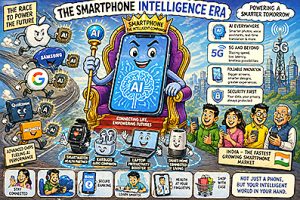
Smartphones Get Smarter: AI, 5G and Foldables Drive the Next Mobile Revolution.
AI Becomes the Core Feature
Artificial Intelligence is no longer an add-on—it is becoming the backbone of the smartphone experience. From real-time language translation and intelligent photo editing to predictive typing and voice assistants, AI is redefining how users interact with their devices. Features like generative AI-powered image creation and context-aware suggestions are now standard in flagship models.
Companies are also focusing on “personal AI,” where the phone learns user behavior over time to provide tailored recommendations, automate tasks, and enhance productivity.
5G Expansion and Beyond
The rollout of 5G technology continues to reshape mobile usage, enabling faster data speeds, lower latency, and improved connectivity. In India, 5G adoption has accelerated rapidly, driving demand for compatible devices and unlocking new use cases such as cloud gaming, AR/VR applications, and high-definition streaming.
Looking ahead, early discussions around 6G are already underway globally, promising even more transformative capabilities in the next decade.
Hardware Innovation: More Power, Less Space
Smartphone hardware is becoming more powerful and efficient. Chipmakers like Qualcomm and MediaTek are launching processors designed specifically for AI workloads, improving battery life while delivering high performance.
Foldable smartphones, led by innovations from Samsung Electronics and others, are also gaining traction, offering users larger screens without compromising portability. Meanwhile, advancements in battery technology and fast charging are addressing one of the most persistent pain points for users.
Camera Wars Continue
The competition in smartphone photography remains intense. Manufacturers are leveraging AI to enhance image quality, enabling features like night photography, real-time object detection, and cinematic video recording. Multi-lens setups and computational photography are pushing the boundaries of what mobile cameras can achieve.
Security and Privacy in Focus
With increasing reliance on smartphones for banking, communication, and work, security has become paramount. Biometric authentication, on-device encryption, and AI-driven threat detection are now standard features. Companies are also emphasizing user privacy, particularly in how data is processed and stored.
The Indian Market: A Key Growth Engine
India remains one of the fastest-growing smartphone markets globally. Rising disposable incomes, affordable data plans, and increasing digital adoption are driving demand across urban and rural areas alike. Domestic manufacturing initiatives and competitive pricing strategies are further strengthening the market.
What Lies Ahead
The future of mobile technology points toward deeper integration of AI, enhanced connectivity, and new form factors. Smartphones may soon act as central hubs for smart homes, wearable devices, and even vehicles, creating a seamless digital ecosystem.
As the lines between hardware, software, and services continue to blur, the smartphone is no longer just a device—it is becoming an intelligent companion, shaping how people live, work, and interact in a digital-first world.