



Changing Sexual Behaviour, Digital Dating and Delayed Diagnosis Fuel New Concerns
By Forever News Research Desk
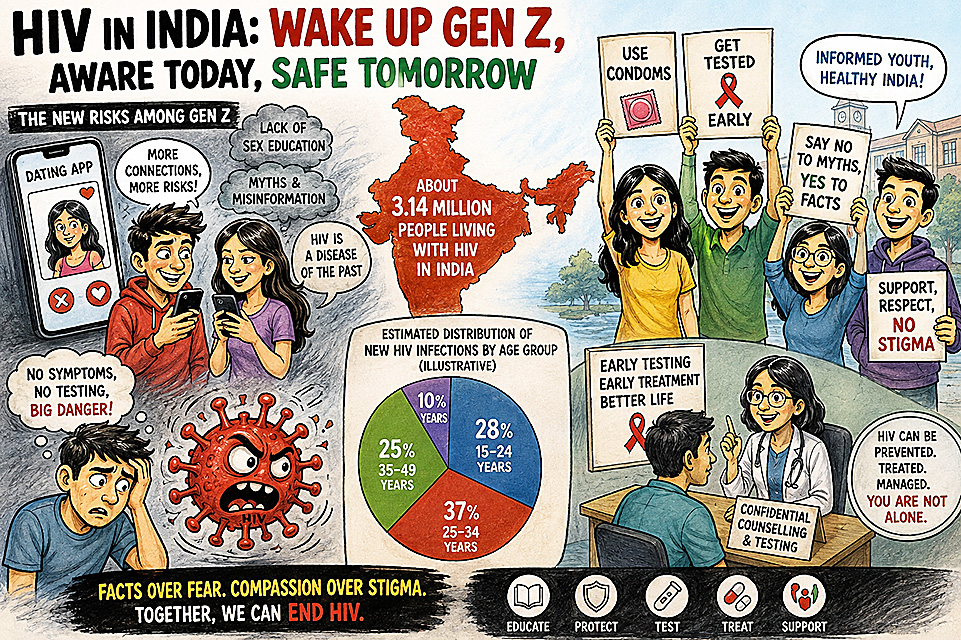
India has made remarkable progress in fighting HIV over the past two decades. New HIV infections have declined significantly since the early 2000s, antiretroviral therapy (ART) is widely available through government programmes, and awareness campaigns have saved countless lives. Yet public health experts are warning of a disturbing new trend: young Indians, particularly Gen Z (aged approximately 15–29), are becoming increasingly vulnerable to HIV due to changing lifestyles, low risk perception, unsafe sexual practices, and inadequate testing. While India is not witnessing an HIV epidemic among Gen Z in the traditional sense, complacency could reverse decades of progress.
India is home to approximately 3.14 million people living with HIV.
India’s HIV Situation
India is home to approximately 3.14 million people living with HIV, making it one of the countries with the largest HIV-positive populations due to its size. However, the national adult HIV prevalence remains relatively low at around 0.2%, indicating that HIV remains concentrated in specific populations rather than the general public.
Major achievements include:
- Significant decline in new HIV infections over the past two decades.
- Expansion of free Anti-Retroviral Therapy (ART) centres.
- Improved prevention of mother-to-child transmission.
- Better access to HIV testing and counselling.
Despite these successes, delayed diagnosis remains a major concern, with many individuals discovering their HIV status only after the disease has progressed.
Why Experts are Concerned About Gen Z
Young Indians today belong to the first generation that did not witness the devastating HIV epidemic of the 1980s and 1990s.
As a result:
- HIV is often perceived as a disease of the past.
- Sexual health education remains inconsistent.
- Condom use is declining in many casual relationships.
- Dating applications have increased opportunities for multiple sexual partners.
- Myths continue regarding HIV transmission and treatment.
Health authorities are increasingly focusing on awareness and screening initiatives in colleges and universities to encourage early testing and reduce stigma.
Estimated Distribution of New HIV Infections by Age Group (Illustrative)
| Age Group | Estimated Share |
|---|---|
| 15–24 years | 28% |
| 25–34 years | 37% |
| 35–49 years | 25% |
| 50+ years | 10% |
Illustrative editorial representation showing why young adults remain a key focus for HIV prevention.
Key Drivers Behind the Rise in Risk
1. Dating Apps
The rapid adoption of dating platforms has changed relationship dynamics among urban youth. While these platforms are not responsible for HIV, they have increased opportunities for casual sexual encounters, making safer sexual practices more important than ever.
2. Poor Condom Usage
Behavioural studies indicate declining condom use among young adults because of misplaced trust, alcohol consumption, impulsive decisions, and reduced fear of HIV.
3. Lack of Comprehensive Sex Education
Many educational institutions still avoid discussions on sexual health.
Young people therefore rely on:
- Social media
- Friends
- Internet influencers
- Online forums
Unfortunately, misinformation often spreads faster than scientific facts.
4. Delayed Testing
Many HIV-positive individuals remain symptom-free for several years.
Delayed diagnosis means infected individuals may unknowingly transmit the virus before receiving treatment.
States Requiring Greater Vigilance
Historically, higher HIV prevalence has been reported in:
- Mizoram
- Nagaland
- Manipur
- Andhra Pradesh
- Telangana
- Karnataka
- Maharashtra
Public health programmes are increasingly focusing on region-specific interventions rather than adopting a uniform national strategy.
Demographic Profile of India’s HIV Burden
| Category | Observation |
|---|---|
| Highest-risk age | 20–39 years |
| Most affected workforce | Young working adults |
| Urban risk | Higher exposure through multiple or casual partnerships |
| Rural risk | Lower awareness and delayed diagnosis |
| Women | Increasing vulnerability through partner transmission |
| Adolescents | Greater need for awareness, counselling and confidential testing |
HIV Transmission in India
The majority of infections occur through:
- Unprotected sexual contact
- Sharing contaminated needles and syringes
- Mother-to-child transmission during pregnancy, childbirth or breastfeeding
- Unsafe blood transfusions (now extremely rare due to strict screening)
HIV is NOT spread through:
- Hugging
- Handshakes
- Sharing food or utensils
- Mosquito bites
- Casual social contact
Social Media and Misinformation
Health experts warn that social media has created a dangerous paradox.
Young people today have unprecedented access to information but are also exposed to myths such as:
- HIV affects only certain communities.
- HIV can be identified by appearance.
- HIV has been completely cured.
- Oral sex carries no risk.
- Healthy-looking people cannot have HIV.
These misconceptions reduce preventive behaviour despite the fact that HIV remains a lifelong infection. With timely diagnosis and proper treatment, however, people living with HIV can enjoy long, healthy and productive lives.
What India Must Do
Experts recommend:
- Comprehensive sexuality education in schools and colleges.
- Wider access to confidential HIV testing.
- Greater promotion of condom use.
- Youth-focused awareness campaigns.
- Expansion of counselling services.
- Stronger social media campaigns to combat misinformation.
- Elimination of stigma associated with HIV testing and treatment.
- Encouraging routine health check-ups among sexually active young adults.
The Road Ahead
India has demonstrated that a coordinated public health response can dramatically reduce HIV infections. However, changing social behaviour, increasing digital interactions, and declining awareness among younger generations present new challenges.
The objective is not to create fear but to promote informed choices. HIV remains preventable, treatable and manageable—but only if people understand the risks and seek timely testing and treatment.
For Gen Z, HIV may no longer dominate headlines as it did decades ago, but that should not lead to complacency. Awareness, responsible behaviour, regular testing and early treatment remain the strongest weapons in India’s fight against HIV.
