
Forever News
Cabinet Approves ₹41,534 Crore Nutrient-Based Subsidy for Kharif 2026
New Delhi: The Union Cabinet, chaired by Prime Minister Narendra Modi, has approved the Nutrient-Based Subsidy (NBS) rates for the Kharif 2026 season, aimed at ensuring the continued availability of key fertilizers to farmers at affordable prices.
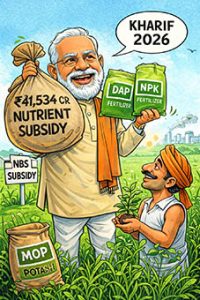
Cabinet Approves ₹41,534 Crore Nutrient-Based Subsidy for Kharif 2026.
The approved subsidy will cover the period from April 1 to September 30, 2026, for Phosphatic and Potassic (P&K) fertilizers, including widely used variants such as DAP and NPKS grades.
The government has earmarked a tentative budget of ₹41,533.81 crore for the Kharif 2026 season. This marks an increase of approximately ₹4,317 crore compared to the ₹37,216.15 crore allocated for the Kharif 2025 season, reflecting rising global input costs and the government’s continued commitment to supporting the agriculture sector.
Focus on Affordability and Supply Stability
The decision is expected to ensure the timely availability of fertilizers at subsidized, reasonable prices, safeguarding farmers against volatility in international markets. By adjusting subsidy rates in line with global price trends of key inputs such as urea, DAP, muriate of potash (MOP), and sulphur, the government aims to maintain price stability at the farm level.
Officials said the move will help rationalize subsidy outgo while ensuring adequate supply, particularly during the critical Kharif sowing season, when demand for fertilizers peaks.
Implementation Framework
Under the approved mechanism, subsidies will be directly provided to fertilizer manufacturers and importers based on the notified NBS rates. This ensures that farmers receive fertilizers at controlled prices without being exposed to fluctuations in global markets.
The scheme will continue to cover 28 grades of P&K fertilizers, reinforcing supply chain stability and enabling farmers to access a variety of nutrient combinations suited to different crops and soil conditions.
Background: NBS Scheme
The Nutrient-Based Subsidy (NBS) scheme has been in operation since April 1, 2010, and remains a key pillar of India’s fertilizer policy. It allows the government to fix per-nutrient subsidy rates annually, thereby promoting balanced fertilization and efficient nutrient use.
With global fertilizer prices remaining volatile due to supply chain disruptions and geopolitical factors, the government’s decision to enhance the subsidy allocation underscores its farmer-centric approach and commitment to food security.
Agricultural Impact
The increased outlay is expected to provide critical support to farmers during the Kharif season, particularly in managing input costs. By ensuring affordability and availability, the policy is likely to contribute to stable crop production and improved farm incomes.