
From Meme to Movement: How the ‘Cockroach Janata Party’ Became India’s Loudest Digital Protest
What started as a sarcastic internet joke has rapidly transformed into one of India’s most talked-about online movements. The so-called “Cockroach Janata Party” (CJP) — born out of frustration, humour and digital rebellion — has exploded across social media, drawing massive attention from young Indians, meme creators, political observers and mainstream commentators alike.
From Meme to Movement: How the ‘Cockroach Janata Party’ Became India’s Loudest Digital Protest.
The bizarrely named movement emerged after controversial remarks allegedly comparing unemployed youth to “cockroaches” triggered outrage online. Within hours, social media users turned satire into protest, creating parody accounts, mock manifestos and viral membership campaigns.
At the centre of the storm is Abhijeet Dipke, the man credited with launching the movement. What began as a sarcastic response soon evolved into a full-fledged digital phenomenon claiming to represent the “voice of the ignored and unemployed.”
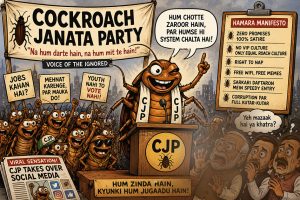
The movement’s popularity lies in its unusual mix of humour and anger. Beneath the memes, absurd slogans and cockroach-themed graphics lies a deeper frustration over unemployment, rising living costs, exam controversies, governance failures and the growing disconnect between India’s youth and traditional political institutions.
The CJP manifesto itself reads like political satire with a sharp edge. It mocks bureaucracy, attacks unemployment and ridicules what supporters describe as performative governance. Yet the movement has struck a chord because it reflects the anxieties of millions of young Indians struggling with jobs, education and economic uncertainty.
As the movement gained traction, reactions poured in from across the political spectrum. Some political observers described it as a warning sign of rising public frustration among young voters, while critics dismissed it as a social media stunt designed to exploit anti-establishment sentiment.
The viral success of the movement has also triggered concerns over fake membership drives and phishing links circulating online in the name of the “Cockroach Janata Party,” prompting warnings from authorities.
Adding another dramatic twist, Maharashtra Police reportedly provided security protection to founder Abhijeet Dipke following the intense online attention surrounding the movement.
What makes the phenomenon politically significant is not whether the “party” ever contests elections, but what it reveals about the changing nature of public dissent in India. Meme politics is no longer confined to jokes and trolling. The Cockroach Janata Party demonstrates how digital satire can evolve into a powerful form of political expression, especially among younger citizens who feel disconnected from conventional politics.
Whether the movement survives beyond the current viral cycle remains uncertain. But for now, the “Cockroach Janata Party” has managed to achieve something many traditional political parties struggle to do — capture the imagination, humour and frustration of an entire internet generation at the same time.