



Forever News
Global Economy at a Crossroads: India Emerges as a Stabilising Force Amid Uncertainty
As the global economy navigates a fragile recovery in 2026, a mix of geopolitical tensions, inflationary pressures, and shifting trade alliances is reshaping the economic order. From the prolonged fallout of the Russia-Ukraine War to rising tensions in West Asia, the world is witnessing what policymakers are increasingly calling a “systemic tremor” — a phase of deep structural uncertainty.
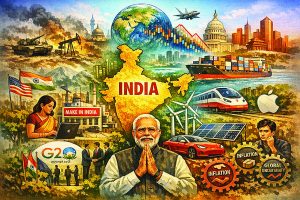
Global Economy at a Crossroads: India Emerges as a Stabilising Force Amid Uncertainty.
Major economies are struggling to balance growth and inflation. The International Monetary Fund recently revised global growth projections downward, citing weak demand in Europe and a slower-than-expected recovery in China. Meanwhile, the Federal Reserve continues to maintain a cautious stance on interest rates, wary of reigniting inflation.
Against this turbulent backdrop, India is steadily positioning itself as a bright spot in the global landscape. With a projected growth rate of over 6.5%, India remains one of the fastest-growing major economies. Structural reforms, digital transformation, and a robust domestic demand cycle are key drivers of this resilience.
Government initiatives such as “Make in India” and the Production-Linked Incentive (PLI) schemes are accelerating manufacturing growth, particularly in sectors like electronics, semiconductors, and renewable energy. Global corporations, including Apple Inc. and Tesla, Inc., are increasingly looking at India as both a manufacturing hub and a strategic market, reflecting a broader shift in global supply chains away from overdependence on China.
India’s leadership role in multilateral forums has also strengthened its global standing. During its recent presidency of the G20, India championed issues such as climate finance, digital public infrastructure, and inclusive growth. Its push for the Global South’s concerns has resonated with developing nations seeking a stronger voice in global governance.
Energy security remains a critical challenge worldwide, especially amid volatile crude prices. India has responded with a dual strategy: diversifying crude import sources while aggressively investing in renewable energy. The country aims to achieve 500 GW of non-fossil fuel capacity by 2030, positioning itself as a leader in the global green transition.
However, risks persist. India is not immune to external shocks, including fluctuations in global commodity prices and export demand. The services sector, particularly IT, faces headwinds from slowing Western economies. Additionally, unemployment and income inequality continue to pose domestic challenges.
Experts believe that India’s long-term trajectory will depend on its ability to sustain reforms, boost infrastructure investment, and enhance skill development. As global capital seeks stable destinations, India’s demographic advantage and policy continuity offer a compelling proposition.
In a world grappling with fragmentation and uncertainty, India’s steady rise presents a narrative of resilience and opportunity. While challenges remain, the country’s evolving role as a bridge between developed and developing economies could prove pivotal in shaping the next phase of global growth.
