



Indian Garment Industry: A Sector at a Crossroads
By Forever News Desk
India’s garment industry stands at an important crossroads. With a huge domestic market, an established textile ecosystem and a large workforce, the sector has the potential to become one of India’s biggest employment and export engines. But rising input costs, global uncertainty and intense competition are forcing the industry to become more competitive.
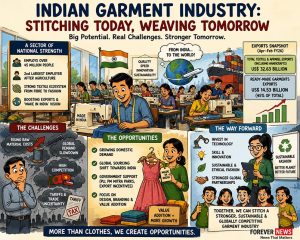
Indian garment industry 2026, India garment exports, textile industry India, apparel industry India, garment manufacturing, Indian textile exports.
India’s textile and apparel exports, including handicrafts, reached US$32.63 billion during April–February FY26, with ready-made garments accounting for US$14.53 billion, or about 45% of the total. The broader textile sector employs more than 45 million people and remains a major source of manufacturing employment.
Export opportunity—and pressure
The opportunity is enormous, particularly as global buyers look to diversify their sourcing beyond China. India has the advantage of an integrated supply chain covering cotton, yarn, fabric and finished garments.
However, the export environment has become challenging. During April–June 2026, India’s textile exports grew 5.19%, but apparel exports declined 12.44%, reflecting weak global demand, higher raw-material costs and geopolitical disruptions.
India’s exporters are also facing pressure in the important US market following new tariff measures, potentially affecting India’s competitiveness against countries such as Bangladesh, Cambodia and Vietnam.
The domestic market provides a cushion
India’s growing middle class, urbanisation, e-commerce and changing fashion preferences are creating strong domestic demand. Organised retail, online fashion platforms and the expansion of branded apparel are transforming how Indians buy clothes.
Casualwear, athleisure, affordable fashion and premium Indian brands are emerging as important growth areas.
Technology will decide the winners
The next phase of growth will not depend only on cheap labour. Indian garment manufacturers will need to invest in automation, modern machinery, digital design, artificial intelligence, efficient supply chains and sustainable production.
Faster turnaround, consistent quality and the ability to produce smaller customised orders will increasingly determine competitiveness.
Government initiatives such as PM MITRA Parks, PLI, technical-textile programmes and export-support measures are aimed at strengthening India’s textile ecosystem. The government has set an ambitious goal of taking textile exports towards US$100 billion by 2030.
From garment maker to global fashion partner
India’s biggest opportunity is to move beyond being a supplier of basic garments. Greater investment in design, branding, product development, man-made fibres, technical textiles and sustainable fashion can help Indian companies capture more value.
The country already has the manufacturing base. The challenge is to combine it with speed, design, technology and global marketing.
The Indian garment industry therefore enters the next few years with both opportunity and uncertainty. If manufacturers can improve productivity, manage costs and build stronger international relationships, India could significantly increase its share of the global apparel market.
The future belongs not simply to the lowest-cost manufacturer, but to the supplier that can deliver quality, speed, sustainability and innovation together.
Forever News — News That Matters
