
Global Rice Powerhouses: India Leads the World’s Food Supply Chain
Rice, the staple food for more than half of the world’s population, is not just a crop—it is a critical pillar of global food security and trade. A small group of countries dominates rice exports, influencing prices, supply, and access to food across continents.
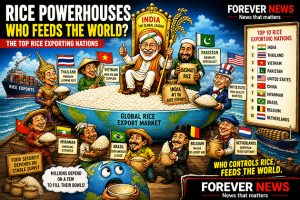
India alone accounts for 35–40% of global exports, making it a critical player in ensuring global food stability.
At the forefront is India, which continues to lead global rice exports by a significant margin. With its vast agricultural base and strong demand for both basmati and non-basmati varieties, India supplies a substantial share of the world’s rice, making it a key player in ensuring food availability for many nations.
Top Rice Exporting Nations
India is followed by other major exporters that play crucial roles in the global rice market:
- Thailand, known for its premium jasmine rice
- Vietnam, a high-volume and cost-efficient supplier
- Pakistan, a leading exporter of basmati rice
- United States, specializing in high-quality varieties
- China, with a growing export presence
- Myanmar, an emerging exporter in Asia
- Brazil, the largest exporter in South America
- Belgium and the Netherlands, acting as key re-export hubs in Europe
Together, these nations dominate global rice trade, supplying millions of tonnes annually to regions that rely heavily on imports.
Why Rice Exports Matter
The importance of rice exports goes beyond trade. Many countries in Africa, the Middle East, and parts of Asia depend on imported rice to meet their food needs. Any disruption in supply—whether due to climate change, policy decisions, or geopolitical tensions—can lead to sharp price increases and food insecurity.
Export restrictions or production shortfalls in major supplying countries can quickly ripple across global markets, highlighting the fragile balance of food supply chains.
Asia at the Core
Asia remains the backbone of global rice exports, with India, Thailand, and Vietnam leading the charge. Their combined output ensures steady supply to global markets, but it also means that any regional disruption can have worldwide consequences.
The Bigger Picture
As climate challenges intensify and global demand rises, the role of top rice-exporting nations becomes even more critical. Ensuring stable production and consistent supply will be key to maintaining global food security in the years ahead.
The Bottom Line
Rice is more than a staple—it is a strategic commodity. The dominance of a few exporting nations, led by India, underscores how global food security depends heavily on the stability and policies of these key players. www.forevernews.in