

Indian Stock Market Shows Resilience Amid Global Uncertainty and Domestic Strength
Mumbai: The Indian stock market continues to demonstrate resilience, navigating a complex mix of global volatility and strong domestic fundamentals. Benchmark indices such as the Nifty 50 and the BSE Sensex have remained steady, reflecting cautious optimism among investors despite intermittent bouts of volatility.
After a strong rally earlier in the year, markets are currently in a consolidation phase, with sectoral rotation playing a key role in sustaining momentum. Banking and financial stocks have emerged as the primary drivers, supported by robust quarterly earnings, improving asset quality, and sustained credit growth. Both private sector lenders and PSU banks have reported strong performances, reinforcing investor confidence.
Infrastructure and capital goods stocks are also witnessing continued buying interest, fueled by the government’s ongoing capital expenditure push and strong order book visibility. These sectors are expected to remain in focus as India continues its infrastructure-led growth trajectory.
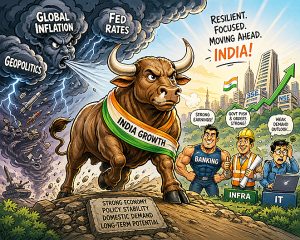
Bull vs Global Storm.
However, not all sectors are sharing the same momentum. The IT sector remains under pressure due to subdued global demand, particularly from key markets like the United States and Europe. Export-oriented companies are facing margin pressures and cautious client spending, which has weighed on investor sentiment.
On the macroeconomic front, India continues to stand out as one of the fastest-growing major economies. Strong GST collections, stable inflation trends, and steady industrial output are supporting the broader market outlook. Domestic Institutional Investors (DIIs) have played a crucial role in stabilizing markets, offsetting intermittent selling by Foreign Institutional Investors (FIIs).
Global cues, however, remain a key overhang. Uncertainty surrounding interest rate decisions by the U.S. Federal Reserve, fluctuating crude oil prices, and ongoing geopolitical tensions continue to influence market sentiment. Investors are closely monitoring these developments for directional cues.
Another critical factor in the coming months will be the monsoon season. A normal monsoon is expected to boost rural demand, which in turn could benefit sectors such as FMCG, automobiles, and agriculture-linked industries. Consumption trends, especially in rural India, will be a key indicator for market direction.
Corporate earnings for the fourth quarter of FY26 have been largely in line with expectations, with strong performances from financials, energy, and infrastructure companies. However, the divergence in sectoral performance suggests that investors need to remain selective.
Looking ahead, analysts expect the market to remain range-bound in the near term, with bouts of volatility driven by global developments. Despite this, the long-term outlook remains positive, supported by India’s strong economic fundamentals, policy stability, and growth prospects.
Investors are advised to focus on fundamentally strong stocks, particularly in banking, infrastructure, and consumption-driven sectors. While midcap and smallcap stocks have delivered strong returns, they may see intermittent corrections, making careful stock selection essential.
In conclusion, while short-term uncertainties persist, India’s stock market continues to offer compelling opportunities for long-term investors, underpinned by a robust economic foundation and sustained growth momentum.