



Weekend Panic: When Markets Sleep, Anxiety Wakes
As the trading bell falls silent on Friday evenings, one might assume that the financial world finally exhales. Screens dim, terminals go quiet, and traders step away from the relentless churn of numbers. Yet, for many investors, the weekend brings not calm—but a different kind of turbulence. Welcome to the phenomenon quietly gripping retail and institutional participants alike: weekend panic.
Unlike weekday volatility, which plays out in real time with the comfort of immediate action, weekend panic is defined by helplessness. There are no trades to execute, no positions to hedge, and no quick exits. Instead, investors are left alone with headlines, speculation, and the ever-active rumor mill. In an age of 24/7 news cycles and social media amplification, this pause in trading often becomes fertile ground for anxiety.
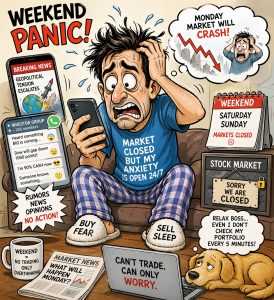
Weekend stock market stress.
Global developments rarely adhere to market hours. A geopolitical flare-up, unexpected economic data from another time zone, or even a sudden corporate announcement can break at any moment. By Saturday morning, WhatsApp groups and financial forums are flooded with interpretations—some informed, many not. Without the ability to respond immediately, narratives tend to spiral, often skewing negative.
Retail investors, especially those new to the market, are particularly vulnerable. With portfolios increasingly accessible through mobile apps, the psychological connection to investments has intensified. What was once a distant, long-term engagement has now become an always-on relationship. As a result, even minor news developments can trigger disproportionate concern.
Institutional investors, while more experienced, are not entirely immune. For them, the stakes are higher, and the pressure to anticipate Monday’s market reaction is immense. Strategy meetings, risk assessments, and scenario planning often stretch across weekends, turning what should be downtime into extended work cycles.
Interestingly, this phenomenon also reflects a broader shift in how markets are consumed. Investing is no longer just about fundamentals and long-term growth—it is increasingly driven by sentiment, speed, and perception. Weekend panic is less about actual events and more about how those events are interpreted in a vacuum of action.
Come Monday morning, reality often diverges from weekend fears. Markets may open flat, or even in positive territory, rendering much of the anxiety misplaced. Yet, the cycle repeats itself week after week, highlighting a deeper behavioral pattern rather than a structural flaw.
Experts suggest a few simple antidotes: limit exposure to unverified news, avoid impulsive decision-making, and most importantly, maintain a long-term perspective. After all, markets are designed to absorb shocks over time—not react to every headline in isolation.
In the end, weekend panic is a reminder that while markets may close, the human mind rarely does. Managing that gap between information and action may well be the next big challenge for modern investors.
