



Forever News
India’s Export Story Has a New Hero: The District
Mumbai | Forever News | Breaking Analysis
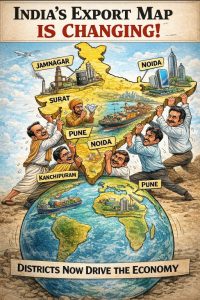
India’s export narrative is undergoing a structural shiftIndia’s export narrative is undergoing a structural shif—and it is happening far from the corridors of New Delhi. The real story lies in districts like Jamnagar, Surat and Gautam Buddha Nagar, which are emerging as the country’s true engines of global trade.
India Export business
Recent export data reveals a striking pattern: a small cluster of districts is contributing disproportionately to India’s outbound shipments. This is not just an economic statistic—it is a structural transformation.
The Jamnagar Effect: Scale That Redefines Trade
At the centre of this shift stands Jamnagar, contributing an astonishing ₹3.96 lakh crore in exports. Powered by the refining might of Reliance Industries, the district has become synonymous with petroleum exports.
This dominance raises an uncomfortable question: Is India’s export strength too concentrated in a few sectors and geographies?
Old Economy Meets New Power Centres
Traditional export hubs like Kanchipuram and Mumbai continue to deliver, leveraging legacy strengths in textiles, gems, finance, and pharmaceuticals.
Yet, the emergence of districts like Pune (auto and engineering) and Gautam Buddha Nagar (electronics manufacturing) signals a deeper industrial evolution.
India is no longer exporting just heritage—it is exporting scale, systems, and specialization.
Surat: The Silent Global Giant
Few places capture this transformation better than Surat. Handling the majority of the world’s diamond processing, Surat is not just a city—it is a global supply chain hub disguised as a district.
And yet, it operates with minimal global recognition compared to its output.
Clusters, Not Countries, Will Define Trade
What is emerging is a new economic logic: countries don’t export—clusters do.
From Kachchh’s port-led exports to Ahmedabad’s industrial diversity and Bharuch’s chemical corridor, India’s export engine is becoming hyper-localized.
This aligns with the government’s “Districts as Export Hubs” vision—but execution remains uneven.
The Risks Beneath the Success
While the numbers inspire confidence, they also expose vulnerabilities:
Heavy reliance on petroleum exports (Jamnagar)
Sector concentration (diamonds in Surat, textiles in Kanchipuram)
Infrastructure gaps beyond top-performing districts
Global demand shocks that can ripple through clustered economies
The question is not whether these districts can grow—it is whether India can replicate this success across hundreds of districts.
The Big Question: Can India Scale This Model?
India’s ambition to become a global export powerhouse hinges on one critical factor: distribution of growth.
If districts like Jamnagar remain outliers, the model risks becoming skewed. But if the ecosystem spreads—through logistics, policy support, and MSME integration—India could unlock a new phase of decentralized economic expansion.
Forever News View
India’s export future will not be written in policy documents alone—it will be built district by district.
The rise of these export hubs is both a success story and a warning. Scale without spread can create strength, but not stability.
The next phase of India’s economic journey will depend on whether more districts can join this elite league—or remain spectators.
