
Leh (Ladakh), Jan 20 (IANS) The curtains went up on the sixth edition of the Khelo India Winter Games (KIWG) at the Nawang Dorjan Stobdan (NDS) Stadium in Leh on Tuesday, with Sports Minister Dr Mansukh Mandaviya saying its organising “sends a clear national signal that winter sports are now an integral part of India’s competitive sporting framework and will be pursued with seriousness, scale, and long-term intent”.
The Ladakh phase of the winter Games, which will host ice sports like skating and hockey, will conclude on January 26. This is the third time that the Union Territory of Ladakh is hosting KIWG. The snow leg of KIWG will be held in Gulmarg, Jammu & Kashmir, later this year.
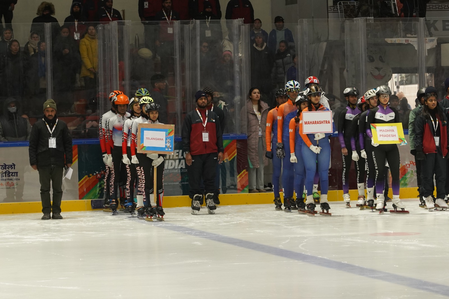
At a colourful opening ceremony, punctuated by traditional music and dance and an exhibition ice hockey match between Army XI and UT Ladakh, the Khelo India Winter Games 2026 were declared open by the Lt Governor of Ladakh, Kavinder Gupta. The first leg of the Khelo India Winter Games 2026 will be organised by the Youth Services and Sports department of the Union Territory of Ladakh under the supervision of the Sports Authority of India. The technical expertise for the conduct of the Games will be provided by the national sports promotional bodies/federations managing ice sports.
In a message to Ladakh, Dr Mansukh Mandaviya, the Minister for Youth Affairs & Sports, said: “I congratulate the Union Territory of Ladakh for successfully hosting the Khelo India Winter Games once again and for demonstrating, with confidence and capability, that India’s winter sports future is being built from the Himalayas outward. Under the visionary leadership of Prime Minister Narendra Modi, Ladakh has emerged as a symbol of what focused policy, infrastructure development, and local commitment can achieve.
“The manner in which these Games have been organised sends a clear national signal that winter sports are now an integral part of India’s competitive sporting framework and will be pursued with seriousness, scale, and long-term intent,” he said.
Dr Mandaviya added, “The Khelo India Winter Games 2026 have been deliberately designed as a two-leg competition, with ice sports in Leh followed by snow events in February at Gulmarg in the Union Territory of Jammu & Kashmir, to build depth, continuity, and high-quality competitive exposure for athletes. This structure allows athletes to test themselves across varied terrains and conditions, closely aligned with international winter sport standards. Such sustained domestic competition is essential if India is to move beyond sporadic participation and steadily build credibility, consistency, and competitiveness in winter Olympic disciplines over the coming years.”
In his speech, LG Kavinder Gupta informed how Ladakh has benefited from Prime Minister Narendra Modi’s vision on the promotion of sports in India. “Under the visionary leadership of Prime Minister Narendra Modi, India’s sporting culture has received a renewed impetus. Through the Khelo India initiative, youth empowerment, physical fitness, and sporting excellence have been elevated as national priorities.”
In all, 1,060 participants, including 480 athletes, will take part in KIWG 2026 to be played across three venues – the new-look NDS Stadium, Gupukh’s Pond, and the Ladakh Scouts Regimental Centre rink. Figure skating, an Olympic sport where Indians are showing international progress, is making its debut at these Games. Some of India’s best skaters will be taking part in this edition of KIWG.
Present in the opening ceremony were Dr Mohd Jaffer Akhoon, the Chief Executive Councillor, Ladakh Autonomous Hill Development Council, Kargil, senior officials of the UT administration, including chief secretary Ashish Kundra, and senior officials of the Sports Authority of India, among others.
In keeping with PM Modi’s vision, LG Gupta said Ladakh was also taking rapid strides in sports development. “Ladakh has recently been endowed with its first-ever Sports Policy. This policy focuses on talent identification at the school level; creating an inclusive sports ecosystem for women and Divyang athletes; strengthening the Ladakh Sports Council; providing four per cent reservation in government jobs for outstanding sportspersons; assured scholarships; cash awards of up to ₹100 crore; development of international-standard sports infrastructure; expansion of centres of excellence; advanced training programmes; incentives for coaches; integration of sports with education; and promotion of sports tourism. This policy will inspire the youth of Ladakh and provide them with pathways to pursue sports professionally.”
–IANS
bsk/