
After Jantar Mantar: India’s Political Landscape Enters a New Phase
Forever News
New Delhi, August 19, 2026: The political tremors triggered by the prolonged student protests at Delhi’s Jantar Mantar have not ended with the dispersal of protesters. Instead, the agitation has evolved into a wider political confrontation, raising questions about youth dissatisfaction, government accountability, the Opposition’s strategy and the future direction of Indian politics.
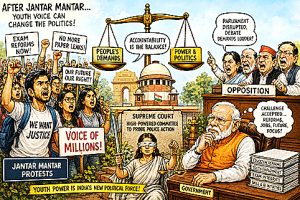
India’s Political Landscape Enters a New Phase.
What began as a protest centred on examination irregularities and the NEET controversy developed into a much larger movement. The resignation of Union Education Minister Dharmendra Pradhan following the sustained agitation gave the protesters a significant political victory and demonstrated that a youth-led movement could force a major response from the Union government.
From Street Protest to Political Issue
The most important development after Jantar Mantar is that the protest has moved beyond the streets.
Opposition parties attempted to carry the issue into Parliament, while the government faced repeated demands for discussion on examination reforms, police action and the grievances of students. The Monsoon Session ended amid substantial disruption, with the Opposition using the Jantar Mantar episode as one of its major political weapons against the government.
The Opposition’s calculation is straightforward: the student movement has created an issue that cuts across conventional political divisions. Employment, competitive examinations, paper leaks, educational opportunities and government accountability are issues that directly affect India’s young population.
For the Opposition, therefore, Jantar Mantar represents more than a protest. It is potentially a political narrative capable of connecting with first-time voters and the expanding aspirational middle class.
Government Faces a Different Challenge
For the Narendra Modi government, the episode presents a different kind of political challenge.
The BJP has traditionally been highly effective at controlling the political narrative around national issues. But the student movement demonstrated the power of social media, youth mobilisation and decentralised political communication.
The government has consequently had to balance two competing objectives: maintaining law and order while avoiding the perception that legitimate student grievances are being suppressed.
The Delhi Police has defended its conduct during the July 20 protest before the Supreme Court, saying that it exercised maximum restraint and used only the minimum force required. Police have also argued that anti-social elements and people with criminal backgrounds had entered the demonstration.
But the controversy has now moved into the judicial arena.
Supreme Court Intervention Changes the Equation
The Supreme Court’s decision to constitute a high-powered committee to examine allegations of police misconduct during the Jantar Mantar protests is politically significant.
The court proceedings have also brought questions about surveillance, facial-recognition technology, deployment of plain-clothes personnel and the proportionality of police action into public debate.
This creates a second front for the government.
The political argument is no longer restricted to examination reforms. It now includes the broader question of how democratic governments should respond when large youth movements take to the streets.
The Opposition Sees an Opportunity
The Opposition has attempted to convert the Jantar Mantar movement into a broader criticism of the Modi government’s governance model.
Leaders have argued that the government cannot avoid accountability simply by refusing or limiting parliamentary debates. Supriya Sule, for instance, described the episode as an intelligence and political failure and argued that the government should be answerable in Parliament.
However, there is also a risk for the Opposition.
If political parties are seen as merely appropriating a genuinely youth-led movement, they could lose credibility with the very demographic they are trying to attract.
The protest movement’s strength came partly from its distance from traditional political parties. That independence could prove more valuable than formal political backing.
The BJP’s Youth Challenge
The biggest long-term question is whether the Jantar Mantar episode represents a temporary protest or the beginning of a new political vocabulary among India’s youth.
The movement demonstrated that young Indians can mobilise rapidly through digital platforms and convert an online campaign into physical political action. Analysts have described the movement as an unusual new challenge to the BJP’s political dominance among younger voters.
The BJP therefore faces the task of reconnecting with young voters on issues beyond nationalism, infrastructure and economic growth.
Employment, education quality, examination integrity, affordable education and opportunities for upward mobility could become increasingly important political themes.
Prime Minister Narendra Modi’s Independence Day address also placed considerable emphasis on youth-oriented initiatives, including AI training and free coaching, while reiterating the government’s development agenda.
Jantar Mantar 2.0?
The movement does not appear to be disappearing completely.
Organisers have indicated plans for another phase of mobilisation, with greater emphasis on education infrastructure and government schools. Reports suggest that a nationwide “listening tour” and documentation of conditions in government schools are being considered.
If this happens, the political significance could be greater than the original protest.
A movement that shifts from demanding the resignation of one minister to documenting systemic problems in India’s education system could develop into a sustained civil-society campaign.
That would be much harder for any political party to control.
Maharashtra Adds Another Political Dimension
The political reverberations are also visible in Maharashtra.
Deputy Chief Minister Eknath Shinde has accused the Opposition of politicising the student protests and argued that issues surrounding NEET should be discussed in Parliament rather than being used purely for street politics.
At the same time, Maharashtra continues to face its own political mobilisation over reservation and community demands. Activist Manoj Jarange has issued an August 28 deadline to the state government for fulfilling demands concerning the Maratha-Kunbi community.
The convergence of student mobilisation, reservation politics and Opposition-government confrontation could make Maharashtra an important political battleground in the months ahead.
The Real Political Message
The most important message from Jantar Mantar may not be about one minister, one examination or one political party.
It is about trust.
Young Indians increasingly expect institutions to be transparent, examinations to be credible and governments to respond quickly when something goes wrong.
The political party that understands this changing expectation could gain an important advantage.
The government still possesses considerable political strength, organisational machinery and a powerful national narrative. The Opposition, meanwhile, has found an issue capable of giving it momentum.
But neither side can assume that the youth movement belongs to them.
What Happens Next?
Three political possibilities are emerging.
First, the government could successfully absorb the anger through examination reforms, administrative action and greater engagement with students. If that happens, Jantar Mantar could eventually become a political episode rather than a political movement.
Second, the Opposition could successfully transform the issue into a national campaign around youth unemployment, examination integrity and institutional accountability.
Third, and potentially the most interesting possibility, is that an independent youth movement could develop outside the traditional BJP-versus-Opposition framework.
That third possibility could be the most consequential.
India’s political system has traditionally been dominated by established parties and personalities. Jantar Mantar has demonstrated the disruptive potential of a different model—digital mobilisation, youth activism, decentralised leadership and issue-based politics.
The Road Ahead
The Jantar Mantar protest has therefore changed the political conversation.
The government must now demonstrate that it can respond to public anger without appearing defensive. The Opposition must demonstrate that it can convert protest into constructive parliamentary politics rather than merely disruption. And the youth movement must demonstrate that it can evolve from agitation into a credible programme for reform.
The coming months will determine whether Jantar Mantar becomes a footnote in India’s political history—or the beginning of a new chapter.
The real battle may no longer be simply between the government and the Opposition. It may increasingly be between traditional politics and a new generation demanding accountability on its own terms.