

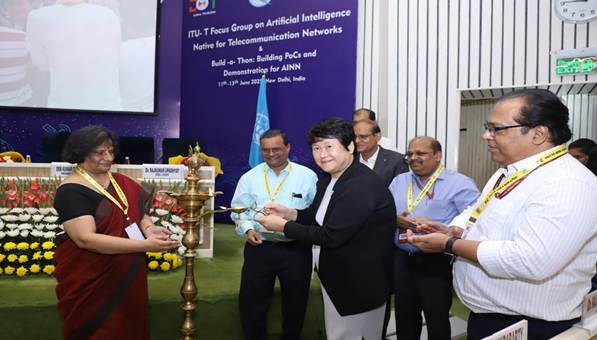
India is spearheading efforts to revolutionize telecommunications with artificial intelligence-native (AI-NN) networks as it hosts the third International Telecommunication Union (ITU-T) Focus Group on AI-Native for Telecommunication Networks (FG-AINN) in New Delhi. Organized by the Telecommunication Engineering Centre (TEC), the technical arm of the Department of Telecommunications (DoT), the event brings together policymakers, industry leaders, and researchers to shape the future of AI-integrated telecom infrastructure.
During the inaugural session, Sanjeev Bidwai emphasized that AI-NN marks a fundamental shift in telecom design, driving intelligent orchestration across domains and enhancing automation in next-generation communication systems. He highlighted India’s contributions, including ‘Bharat Gen’, the country’s first indigenously developed government-funded AI-based Multimodal Large Language Model (LLM) for Indian languages. Other initiatives by IITs and C-DOT in network automation and digital twins were also showcased. Bidwai stressed the importance of deploying AI ethically, ensuring digital sovereignty, and evolving regulatory frameworks for AI-driven networks.
In a video address, Seizo Onoe, Director of ITU’s Telecommunication Standardization Bureau, underlined the transformative potential of AI-NN in delivering next-generation performance through intelligent automation, self-management, and real-time network optimization. Atsuo Okuda, ITU Regional Director for Asia-Pacific, described the region as a global digital innovation hub, highlighting the need for collaborative frameworks to bridge digital divides and fuel AI adoption across sectors like smart cities, healthcare, and education.
India also used the platform to seek support for hosting the ITU Plenipotentiary Conference 2030 (PP-30) and continued membership in the ITU Council (2027-2031). The country put forward its nomination of M. Revathi as the first woman and first regional candidate for Director of the ITU Radiocommunication Bureau (2027-30).
The event witnessed participation from top Indian officials, including Niraj Verma, Rudra Narayan Palai, Deb Kumar Chakrabarty, Shubhendu Tiwari, Dr. Rajkumar Upadhyay, Tripti Saxena, and other senior representatives from DoT, academia, and industry.
Established in July 2024 by ITU-T Study Group 13, FG-AINN focuses on fundamental changes required in network architecture to harness AI’s full potential. The group aims to embed AI at the core of telecom networks, creating self-optimizing, resilient systems that offer seamless connectivity, fewer call drops, faster mobile data, and real-time adaptability.
Discussions at the meeting covered topics such as federated learning for telecom, AI/ML models for next-gen wireless systems, AI-driven 6G applications, autonomous AI agents, and facial recognition-based SIM verification. The event features interactive technical reviews, expert discussions, and a collaborative Build-a-Thon, where participants will co-create AI-native concepts and prototype solutions for intelligent networks.
With AI-NN poised to reshape the global telecom landscape, India’s leadership in this domain reinforces its position as a key innovator in advanced communication technologies.