
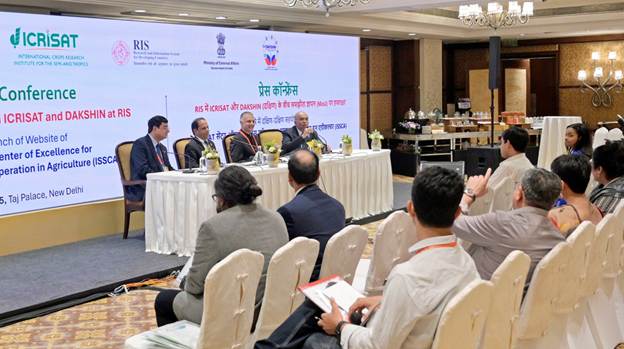
The International Crops Research Institute for the Semi-Arid Tropics (ICRISAT), in collaboration with the Research and Information System for Developing Countries (RIS), has launched the ICRISAT Centre of Excellence for South-South Cooperation in Agriculture (ISSCA). This initiative aims to accelerate agricultural innovation and knowledge exchange across the Global South, strengthening cooperation in sustainable farming practices and climate-smart agriculture.
The launch was accompanied by the signing of a strategic Memorandum of Understanding (MoU) between ICRISAT and DAKSHIN (Development and Knowledge Sharing Initiative), a Government of India-backed initiative dedicated to facilitating partnerships and capacity building among countries in the Global South. The collaboration is expected to scale agricultural innovations, enable policy models tailored to dryland regions, and establish a digital portal for knowledge exchange.
Speaking at the event, ICRISAT Director General Dr. Himanshu Pathak emphasized that nations in the Global South possess a wealth of local expertise and innovative solutions, but need more coordinated investment and partnerships to unlock their full potential. He reiterated ICRISAT’s commitment to supporting agricultural transformation by leveraging science-driven interventions, technology transfer, and inclusive growth strategies.
RIS Director General Professor Sachin Chaturvedi hailed the partnership as a catalyst for strengthening agricultural production and processing systems, enabling sustainable farming through digital innovations and climate-smart solutions. He underscored DAKSHIN’s role in identifying and sharing scalable agricultural models that can contribute to economic growth and food security across developing nations.
Further reinforcing India’s commitment to agricultural advancement, Department of Agricultural Research and Education Secretary Dr. Mangi Lal Jat, who also serves as Director General of the Indian Council of Agricultural Research (ICAR), highlighted ICAR’s proactive approach in collaborating with ISSCA. He noted that such partnerships are instrumental in fostering global agricultural resilience while ensuring equitable access to modern farming technologies for nations facing climatic and socio-economic challenges.
The ISSCA initiative is set to reshape agricultural cooperation, providing a dedicated platform for knowledge exchange, low-cost farming technologies, and climate-resilient agricultural strategies. As India strengthens its role in global agricultural leadership, the centre is expected to play a pivotal role in enhancing food security, sustainability, and economic transformation across the Global South.