

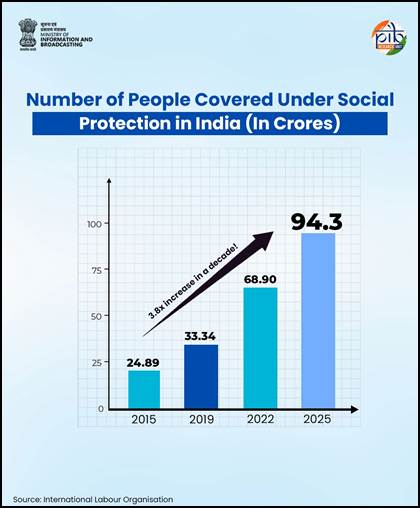
India has achieved a remarkable milestone in social protection coverage, expanding from 19 percent in 2015 to 64.3 percent in 2025. This translates to over 943 million individuals receiving at least one social security benefit, marking a 45 percentage point increase over a decade and positioning India as the second-largest provider of social protection globally after China. The International Labour Organization (ILO), through its ILOSTAT database, has acknowledged this surge as one of the most significant expansions in the world. The shift has taken India from covering 333 million people in 2015 to over 943 million in 2025, representing a 3.8-fold increase in ten years.
The Ministry of Labour and Employment, working alongside the ILO, is undertaking a national social protection data pooling initiative to consolidate beneficiary data across 34 major central schemes, including MGNREGA, EPFO, ESIC, APY, and PM-POSHAN. This effort uses encrypted Aadhaar as a universal identifier. The initial phase, covering states such as Uttar Pradesh, Rajasthan, Maharashtra, Madhya Pradesh, Tamil Nadu, Odisha, Andhra Pradesh, Telangana, Karnataka, and Gujarat, will create a centralised beneficiary map for better targeting and sustainable financing. India is the first country to update its 2025 social protection data into ILOSTAT, reflecting its leadership in digital governance and commitment to building a transparent, rights-based welfare system.
This unprecedented coverage expansion strengthens India’s ability to negotiate Social Security Agreements with developed countries, allowing Indian professionals greater benefit portability while assuring partner countries of India’s accountability through verified systems.
The transformation has been driven by a wide array of central government reforms and schemes implemented over the past 11 years. Simplification of laws was a cornerstone. With more than 500 million workers, nearly 90 percent in the unorganised sector, the government consolidated 29 labour laws into four codes: the Wage Code, the Social Security Code, the Occupational Safety, Health and Working Conditions Code, and the Industrial Relations Code. The Social Security Code of 2020 is a landmark framework that extends benefits like insurance, pensions, maternity, and gratuity to all workers, including those in the unorganised sector. It enables employer and worker contributions, with government support for economically disadvantaged groups.
A small contribution now offers access to ESIC hospitals and dispensaries for all workers, including those in the unorganised and gig sectors, hazardous industries, and plantations. The ESIC network is expanding to all 740 districts, covering even single workers in hazardous environments. The code also brings pension benefits through EPFO to self-employed and fixed-term employees, removes service requirements for gratuity, and mandates employers with over 20 workers to report vacancies online. A universal Aadhaar-based account number ensures portability of benefits.
The social security revolution has been further bolstered by digital and financial infrastructure. The Jan Dhan Yojana has enabled over 556 million to access formal banking. Aadhaar has established a digital identity backbone with over 1.42 billion cards issued. Direct Benefit Transfers have saved approximately USD 41.7 billion by reducing leakages. With 5G now reaching 99.6 percent of Indian districts and data costs plummeting from USD 3.70 per GB in 2014 to under 12 cents by 2022, digital inclusion has become a reality for the masses.
Key social security schemes have expanded in tandem. As of May 2025, 510.6 million people are enrolled under Pradhan Mantri Suraksha Bima Yojana, and 236.4 million under the Jeevan Jyoti Bima Yojana. Over 5.1 million workers are enrolled under PM Shram Yogi Maandhan Yojana, receiving pensions after age 60. The EPFO added 12.9 million net subscribers in 2024–25, with 1.9 million joining in April alone, showing strong formal job creation. ESIC continues to safeguard workers with health, sickness, and unemployment benefits.
The e-Shram portal, launched in 2021, has registered 309.1 million unorganised workers, 53.77 percent of them women. The Atal Pension Yojana has 72.5 million subscribers and a corpus of USD 5.2 billion. The PM Vishwakarma Yojana supports traditional artisans with collateral-free loans, tools, and digital literacy, already reaching 2.37 million with 1 million toolkit disbursals.
Women and households have received focused attention. More than 100 million women are part of Self-Help Groups, and 30 million are set to become “Lakhpati Didis.” The PM Ujjwala Yojana has delivered over 103.3 million free LPG connections. Nearly 40 million homes have been completed under PM Awas Yojana — with 9.27 million under urban and 27.7 million in rural areas. Of these, over 90 lakh homes are owned by women and 60 percent allocated to SCs and STs in rural areas.
Health coverage has been expanded through Ayushman Bharat. Over 412.9 million Ayushman Cards have been issued, backed by more than 32,000 hospitals. The Ayushman Vay Vandana scheme further extends health coverage to citizens over 70 years of age, regardless of income. The digital mission now connects 770 million Health IDs for seamless service delivery.
Food security through PM Garib Kalyan Anna Yojana has reached over 806.7 million people with free food grains. For persons with disabilities, the ADIP scheme has provided assistive devices worth over USD 290 million to more than 3.1 million beneficiaries through 18,000 camps since 2014. It also expanded recognised disabilities from 7 to 21 types.
For the transgender community, the government has launched the SMILE scheme, including 12 pilot “Garima Greh” shelter homes, ensuring safety and rehabilitation.
This vast web of interconnected schemes and legislative reforms reflects India’s intent to build a more inclusive and secure society. With additional schemes pending ILO verification and Phase II of the data pooling underway, total social protection coverage is expected to surpass 1 billion beneficiaries in the near future, cementing India’s place as a global leader in welfare delivery.