
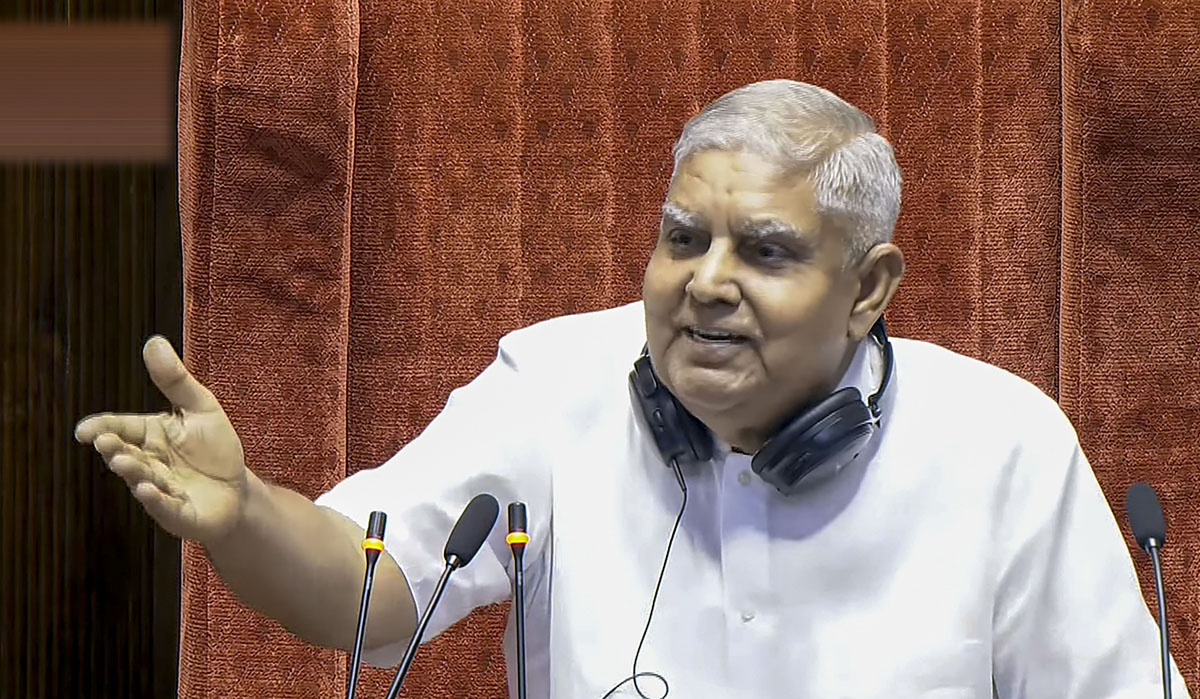
Vice-President Jagdeep Dhankhar strongly criticised the 1976 amendments to the Preamble of the Indian Constitution, calling them an unjust distortion of its foundational spirit. Speaking at an event held at the Vice-President’s Enclave to mark the presentation of Ambedkar’s Messages compiled by D. S. Veeraiah, he asserted that the words “Socialist”, “Secular” and “Integrity”, added during the Emergency through the 42nd Constitutional Amendment, were imposed when the nation’s democratic principles were under siege.
Calling the Preamble the “soul of the Constitution” and a sacred construct imparted by “We, the People of India,” he argued that it should have remained untouched. He noted that no other constitution in the world had altered its Preamble. By contrast, Bharat did so, and that too under what he described as the “darkest period of Indian democracy,” when rights were suspended and leaders languished in jail. Quoting the Kesavananda Bharati verdict and jurists like Justices H. R. Khanna, Hidayatullah, Sikri, Hegde, and Mukherjee, he said the Preamble encapsulates the ideals and aspirations of the Constitution and cannot be modified lightly.
He decried the changes as “a travesty of justice”, done in an atmosphere where “We the People” were denied access to the courts and freedom of expression. He referred to the 22-month Emergency that began on 25 June 1975 as a time of civil and political subjugation, arguing that the changes added not strength, but festering wounds — “nasoor” — to the constitutional fabric. He said the changes militated against the “Sanatan spirit” and civilisational knowledge that had guided Bharat for millennia.
Dwelling on the legacy of B. R. Ambedkar, he said the architect of the Constitution must never be seen through a political lens. He urged citizens to recognise Ambedkar’s contribution not just as a jurist and reformer but as a statesman whose work forms the moral and intellectual bedrock of Indian democracy. Referring to Ambedkar’s last address to the Constituent Assembly on 25 November 1949, Dhankhar invoked his words on unity and national loyalty, quoting, “I want all people to be Indian first, Indian last, and nothing else but Indians.”
He reflected with emotion on the fact that Ambedkar was conferred the Bharat Ratna only posthumously, in 1990, and said it was a moment of regret despite its symbolic value. He called upon legislators, policymakers, and youth to read Ambedkar’s speeches and writings deeply, especially his warnings on placing creed above country and the dangers it could pose to India’s hard-won independence.
He also questioned the state of Parliament today, asking why the “temples of democracy” face disruption and degradation, and urged introspection on what he called the sanctity of legislative conduct.
Dhankhar closed with an appeal to the nation to uphold the original essence of the Constitution and its Preamble, cautioning that straying from its foundational values could amount to undermining the philosophical and civilisational ethos of Bharat itself.