

Skill Development: The Cornerstone of Employment Generation in India
Skill Development Emerges as the Cornerstone of Employment Generation in India.
As India continues its journey towards becoming a global economic powerhouse, skill development has emerged as one of the most effective instruments for employment generation. With nearly one million young Indians entering the workforce every month, equipping them with industry-relevant skills has become essential for sustaining economic growth and improving livelihoods.
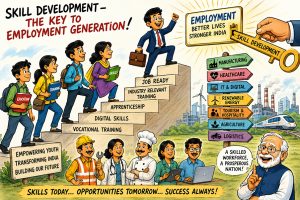
Skill Development Emerges as the Cornerstone of Employment Generation in India.
India’s demographic advantage is one of its greatest strengths. However, this advantage can only be fully realised if the country’s youth possess the technical, vocational and digital skills required by rapidly evolving industries. The emphasis is therefore shifting from merely creating jobs to creating a workforce that is skilled, productive and globally competitive.
One of the major challenges facing India’s labour market is the mismatch between educational qualifications and industry requirements. While millions of graduates complete their education every year, employers across sectors continue to report shortages of skilled professionals. Skill development programmes are designed to bridge this gap by providing practical training, vocational education and certification aligned with market needs.
The demand for skilled manpower is growing across manufacturing, construction, healthcare, information technology, logistics, tourism, renewable energy, agriculture, retail and financial services. Emerging sectors such as artificial intelligence, cybersecurity, robotics, data analytics, electric vehicles and green technologies are also creating entirely new categories of employment that require specialised skills.
Government initiatives under the Skill India Mission have significantly expanded access to vocational education and skill training across the country. Programmes focusing on youth, women, school dropouts and rural populations are helping create employment opportunities while improving productivity and incomes. Industrial Training Institutes (ITIs), apprenticeship programmes and vocational training centres are playing a crucial role in preparing job-ready candidates.
Apprenticeship has become an important component of workforce development by allowing young people to gain practical industry experience while earning a stipend. This “learn while you earn” model not only improves employability but also enables industries to recruit workers who are already familiar with real workplace environments.
Skill development is equally important for rural India. Training in agriculture, food processing, handicrafts, tailoring, digital services, plumbing, electrical work and small-scale manufacturing is enabling rural youth to become self-reliant. Women are increasingly benefiting from entrepreneurship training, financial literacy and digital skills, leading to greater economic participation and financial independence.
Another significant outcome of skill development is the promotion of entrepreneurship. Rather than seeking employment alone, many trained individuals are establishing micro and small enterprises in sectors such as food processing, repair services, beauty and wellness, digital marketing, mobile servicing and local manufacturing. These enterprises not only generate income for entrepreneurs but also create additional employment opportunities within local communities.
Industry participation has become increasingly important in designing skill development programmes. Companies are collaborating with training institutions to ensure that course content reflects current technologies, operational practices and future workforce requirements. Such partnerships improve placement rates and reduce the gap between education and employment.
Digital transformation is reshaping the employment landscape at an unprecedented pace. As businesses adopt automation, cloud computing, artificial intelligence and advanced manufacturing technologies, continuous upskilling and reskilling have become essential. Lifelong learning is no longer optional but necessary for professionals to remain relevant in an increasingly competitive job market.
Despite considerable progress, several challenges remain. Improving the quality of training, strengthening placement support, expanding access to rural areas, encouraging greater industry participation and ensuring regular curriculum updates will be vital for the long-term success of India’s skill ecosystem.
Skill development has become more than an employment initiative—it is a national economic strategy. A skilled workforce enhances productivity, attracts investment, strengthens manufacturing competitiveness and supports innovation. As India aspires to become a global manufacturing and services hub, investment in human capital will remain one of the strongest drivers of inclusive and sustainable economic growth.
Creating jobs alone will not be sufficient for India’s future. The real success will lie in building a workforce that is adaptable, technologically proficient and capable of meeting the demands of a rapidly changing global economy. Skill development, therefore, will continue to be the cornerstone of employment generation and India’s long-term development.
www.forevernews.in