



By Forever News Research Desk
India’s poultry industry has emerged as one of the country’s most successful agricultural sectors, transforming from a small-scale backyard activity into a modern, technology-driven agribusiness. Today, the industry plays a vital role in ensuring food security, generating employment, and contributing significantly to the nation’s economy.
Approximate share of major poultry business segments in India (industry estimates).
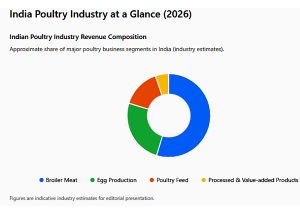
India Poultry Industry at a Glance (2026).
With an estimated annual value of nearly ₹2.5 lakh crore, the poultry sector provides direct and indirect employment to over 6 million people and has consistently recorded an annual growth rate of 7–8 percent. India is now the third-largest producer of eggs and the fourth-largest producer of broiler meat in the world, reflecting the industry’s rapid expansion and increasing efficiency.
The sector comprises four major segments—broiler meat production, egg production, poultry feed manufacturing, and processed poultry products. Broiler meat accounts for nearly 55 percent of the industry’s total business, followed by egg production at 25 percent, poultry feed at 15 percent, and processed and value-added products at 5 percent. While fresh poultry continues to dominate the domestic market, demand for hygienically processed, ready-to-cook, and packaged chicken products is steadily increasing, particularly in urban India.
India currently produces around 150 billion eggs annually, while broiler meat production is estimated at 5.5 to 6 million tonnes. Despite being one of the world’s leading producers, per capita consumption remains relatively low compared to global averages. The average Indian consumes about 100 to 110 eggs and 5 to 6 kilograms of chicken meat each year, indicating significant room for future growth as awareness of protein-rich diets continues to increase.
The southern states continue to dominate commercial poultry production. Andhra Pradesh, Telangana, Tamil Nadu, Karnataka, and Maharashtra account for a substantial share of the country’s output due to better infrastructure, integrated farming practices, and the presence of large poultry companies. Punjab, Haryana, and West Bengal are also important contributors to the industry.
One of the defining features of India’s poultry business is the growth of integrated farming. Large companies provide farmers with day-old chicks, feed, medicines, veterinary support, and technical guidance, while farmers focus on raising the birds. This contract farming model has reduced financial risks for small farmers while ensuring consistent quality and supply.
Some of the country’s leading poultry companies include Suguna Foods, Venky’s (India) Ltd., Srinivasa Farms, Godrej Tyson Foods, IB Group, Skylark Foods, Sneha Farms, and CP India. These companies have expanded beyond conventional poultry farming into hatcheries, feed manufacturing, meat processing, cold-chain logistics, and exports, making the industry increasingly organized and competitive.
Feed remains the single largest expense for poultry farmers, accounting for nearly 70 percent of production costs. Maize and soybean meal are the primary ingredients used in poultry feed, making fluctuations in agricultural commodity prices a major concern for the industry. Rising feed costs directly impact farm profitability and consumer prices.
Technology has become an integral part of modern poultry farming. Climate-controlled sheds, automated feeding systems, digital farm management, artificial intelligence for disease detection, and precision nutrition are helping farmers improve productivity while reducing mortality rates. These technological advancements have made Indian poultry farming more efficient and globally competitive.
The industry is also witnessing growing investment in processed poultry products as changing lifestyles and rising incomes increase demand for convenience foods. Restaurants, hotels, quick-service restaurant chains, supermarkets, and online meat delivery platforms are creating new opportunities for value-added poultry products across urban markets.
India’s poultry exports include table eggs, egg powder, frozen chicken, and processed poultry products, with key markets in the Middle East, Africa, and parts of Asia. Although exports are gradually increasing, there remains considerable potential for expansion through better cold-chain infrastructure, improved processing facilities, and stronger compliance with international quality standards.
Despite its remarkable growth, the sector continues to face several challenges. Feed price volatility, outbreaks of avian influenza, climate change, heat stress, inadequate cold-chain infrastructure, and disease management remain major concerns. However, continuous investments in biosecurity, automation, vaccination, and scientific farm management are helping the industry become more resilient.
Industry experts believe that India’s poultry sector is well-positioned for sustained long-term growth. Rising urbanisation, increasing disposable incomes, greater awareness of nutrition, and changing food habits are expected to drive higher consumption of chicken and eggs over the coming years. The expansion of organized retail, food processing, and exports is likely to further strengthen the industry’s contribution to India’s agricultural economy.
With its strong growth fundamentals, expanding domestic demand, and increasing adoption of modern farming technologies, the Indian poultry industry is expected to remain one of the country’s most promising agribusiness sectors, creating new opportunities for farmers, entrepreneurs, investors, and food processors while contributing significantly to rural development and national food security.
