



Mumbai’s Air Quality Deteriorates After Monsoon, Construction Dust and Traffic Add to Pollution Burden
Mumbai: Mumbai’s post-monsoon haze has renewed concerns over the city’s air quality, as dry weather, construction activity, road dust and traffic emissions combine to make pollution a growing urban challenge. Although the city has recorded a substantial number of days with relatively clean air this year, recent readings underline how quickly conditions can change once the monsoon retreats.
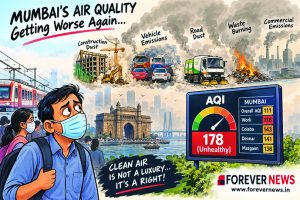
Mumbai’s Air Quality Deteriorates After Monsoon, Construction Dust and Traffic Add to Pollution Burden.
Between October 1 and 23, the Central Pollution Control Board (CPCB) dashboard classified Mumbai’s air quality in the moderate category on 11 days, while IQAir classified it as unhealthy on all 23 days. The two platforms use different monitoring networks and air-quality assessment methods, which partly explains the difference.
On October 3, Mumbai’s overall Air Quality Index (AQI) stood at 111, with Worli recording 178, Colaba 143, Deonar 141 and Mazgaon 138. These readings followed four months, from June to September, when the city’s AQI generally remained below 100, helped by rainfall that washed suspended dust and pollutants out of the air.
The deterioration became more pronounced in the middle of the month. On October 15, IQAir ranked Mumbai fifth among 122 monitored global cities and first in India. Its reported AQI reached a peak of 188 on October 17, while the CPCB’s peak reading during the October 1–23 period was 127 on October 18. The figures illustrate both the changing pollution conditions and the importance of understanding which monitoring system is being used.
Why Mumbai’s air is deteriorating
The seasonal transition after the monsoon plays a significant role in Mumbai’s pollution cycle. With rainfall declining, dust and particulate matter are no longer washed out as frequently. Changes in wind direction, weaker air circulation and prolonged dry spells can allow pollutants to accumulate closer to the ground.
Construction and redevelopment projects, infrastructure work, vehicle exhaust, road dust, waste burning and emissions from certain commercial activities add to the burden. Mumbai’s dense urban development and the concentration of construction activity in several neighbourhoods make pollution levels uneven across the metropolitan region.
Fine particulate matter, particularly PM2.5, is a major concern because these tiny particles can penetrate deep into the lungs. PM10 includes larger inhalable particles, often associated with road dust, construction and other mechanical activities.
BMC steps up enforcement
The Brihanmumbai Municipal Corporation (BMC) has announced several measures to tackle pollution. The civic body said Mumbai had recorded 231 days with good or satisfactory AQI levels in 2026 up to October 22, compared with 222 such days during the whole of 2025.
The BMC has introduced 28 pollution-control guidelines for construction sites and deployed 76 ward-level inspection squads. It has also made sensor-based air-quality monitoring mandatory at construction sites, with 3,166 sites reported to have installed monitors linked to a central dashboard.
Other measures include deep cleaning of roads, the deployment of 29 multipurpose vehicles for routine sweeping, action against open waste burning and efforts to move bakeries away from polluting fuels. Of the 593 bakeries cited by civic officials, 209 were already using cleaner fuels, another 175 had shifted, 69 were in the process of conversion, 87 remained non-compliant and eight had shut down.
These figures indicate that enforcement has begun to expand, but the challenge lies in ensuring that regulations translate into sustained improvements in the air people breathe.
A public-health concern beyond winter
Poor air quality can aggravate asthma and other respiratory conditions, while prolonged exposure to fine particulate pollution is associated with cardiovascular and respiratory disease. Children, older people and those with existing heart or lung conditions are particularly vulnerable.
The AQI also needs to be interpreted correctly. Under India’s CPCB classification, 0–50 is good, 51–100 satisfactory, 101–200 moderate, 201–300 poor, 301–400 very poor and 401–500 severe. An AQI below 100 is therefore not a guarantee that all pollutants are harmless, and daily citywide averages can conceal localised pollution hotspots.
Mumbai’s experience highlights a recurring problem: the monsoon can temporarily improve air quality, but the underlying sources of pollution remain. A durable response requires continuous dust suppression at construction sites, effective debris management, cleaner transport, strict action against open burning, reliable monitoring and transparent public reporting.
For a city whose economy depends on mobility, infrastructure and dense commercial activity, clean air must become a year-round priority rather than a seasonal campaign. The real test will be whether the measures announced by civic authorities lead to consistent, measurable improvements across neighbourhoods—not merely a temporary fall in the AQI after rainfall or a change in wind conditions.
