

THE ALGORITHM THAT COULD DESTABILISE INDIA
India’s next security threat may not arrive across a border. It could arrive on a smartphone.
By Forever News Investigative Desk
India has spent decades preparing for conventional threats—terrorism, cyberattacks, military aggression, economic warfare and espionage.
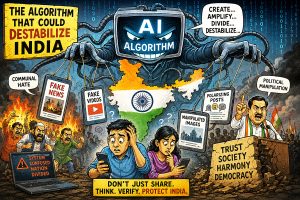
THE REAL THREAT: ALGORITHMIC AMPLIFICATION.
But a new battlefield is emerging, and it has no clearly defined border.
It exists inside social-media feeds, messaging platforms, search engines and increasingly, artificial-intelligence systems.
The weapon is not necessarily a missile or malware.
It can be a narrative.
Artificial intelligence can now generate thousands of apparently authentic messages, photographs, videos, voices and articles at a speed no human propaganda operation could previously match. Recommendation algorithms can then identify which material generates the strongest emotional response and distribute it to increasingly receptive audiences.
The result is a potentially dangerous feedback loop:
Create → amplify → target → provoke → polarise → repeat.
There is no evidence that a single AI system has been secretly programmed to destabilise India. The greater concern is more sophisticated: multiple AI tools and algorithms can be combined by hostile states, political operators, criminal networks, ideological groups or anonymous actors to manipulate India’s information environment.
That possibility deserves serious national attention.
THE NEW INFORMATION WAR
Traditional propaganda required people.
Someone had to write the message, design the poster, create the video, translate it and distribute it.
Generative AI changes the economics completely.
A single operator can now produce content in multiple Indian languages, create different versions for different communities, generate realistic voices and images, and continuously test which version receives the greatest engagement.
The technology does not need to convince everybody.
It only needs to influence enough people to create uncertainty, anger or distrust.
The World Economic Forum has identified misinformation and disinformation among the major short-term global risks, warning that AI-generated synthetic media and psychological manipulation can intensify social polarisation and undermine democratic institutions.
For a country as large and diverse as India, the challenge is amplified by its enormous linguistic, cultural and regional diversity.
THE FIVE-STAGE DESTABILISATION MODEL
- Manufacture
AI generates apparently authentic content.
A fabricated video of a politician.
A fake statement from a military officer.
A manipulated speech.
A synthetic photograph.
A fake government order.
A fabricated communal incident.
A false stock-market rumour.
A fake message claiming that a particular community has been attacked.
The possibilities are virtually unlimited.
- Localise
The same narrative can be rewritten for different audiences.
English for urban professionals. Hindi for North India. Tamil for Tamil Nadu. Malayalam for Kerala. Bengali for West Bengal. Marathi for Maharashtra. And so on.
The narrative can be culturally adapted to make it appear locally generated.
- Amplify
Automated or coordinated accounts can repeatedly distribute the material.
The objective is not necessarily to make one post go viral.
It can be to create the perception that “everybody is talking about this.”
That perception itself can influence human behaviour.
- Trigger
Algorithms are particularly effective at identifying emotionally powerful content.
Anger.
Fear.
Humiliation.
Religious sentiment.
Nationalism.
Economic anxiety.
Community identity.
Political resentment.
Content provoking a strong reaction is more likely to generate engagement—and engagement can lead to further distribution.
- Normalise
After repeated exposure, a fabricated claim can begin to feel familiar.
The question changes from:
“Is this true?”
to:
“How can this possibly be false when everyone is talking about it?”
That is the point at which information warfare becomes particularly dangerous.
INDIA’S UNIQUE VULNERABILITY
India is simultaneously one of the world’s largest democracies, one of the world’s largest internet markets and one of the most linguistically diverse societies.
That creates enormous opportunities for AI—but also creates a complex attack surface.
A campaign that fails in English may succeed in another language.
A narrative rejected in Mumbai may gain traction elsewhere.
A fabricated local video may be more influential than an obviously false national story.
And an AI system trained predominantly on information from one linguistic or cultural environment may misunderstand Indian context.
Recent research into AI evaluation specifically for India highlights this problem. Researchers have argued that conventional benchmarks are heavily English- and Western-centric and may fail to identify safety, fairness and cultural-knowledge weaknesses relevant to India’s 22 officially recognised languages and diverse communities.
THE MOST DANGEROUS WEAPON MAY BE TRUST
The ultimate objective of sophisticated disinformation may not be to make people believe a lie.
It may be to make people believe nothing.
If citizens cannot determine whether a video is genuine, whether an audio recording is real, whether a government announcement is authentic or whether an image has been generated by AI, institutional trust begins to deteriorate.
This produces what could be called the “liar’s dividend.”
Once deepfakes become commonplace, even genuine evidence can be dismissed as fake.
A genuine speech can be called AI-generated.
A real photograph can be labelled manipulated.
A legitimate government communication can be questioned.
Truth itself becomes contestable.
FROM SOCIAL MEDIA TO AI ANSWER ENGINES
The problem is moving beyond Facebook, Instagram, YouTube and X.
Millions of people increasingly ask AI systems questions directly.
That creates a new battlefield.
If misleading information is systematically placed across websites, social networks and online publications, future AI systems may retrieve and synthesise that material when answering questions.
Recent research examining AI answer engines and conflict information found that where the underlying information record is thin, AI systems are more vulnerable to inventing, misattributing or miscounting facts. The researchers also warned that deliberate optimisation of online sources to influence AI-generated answers is emerging as a potential information-warfare technique.
This raises an uncomfortable question:
What happens when propaganda stops targeting humans directly and starts targeting the machines humans trust for information?
That could become the next generation of information warfare.
THE DEEPFAKE MOMENT
The technology has crossed an important threshold.
Earlier deepfakes often contained obvious visual imperfections.
That is changing.
AI can now produce increasingly convincing faces, voices, photographs and videos.
The danger is particularly acute during: elections, communal tensions, military crises, terrorist attacks, natural disasters
financial-market disruptions
major diplomatic incidents
Imagine a fabricated video appearing minutes after a major national-security event.
It appears to show a senior official making an inflammatory statement.
Thousands of accounts circulate it.
Television channels begin discussing it.
Politicians react.
Markets respond.
Foreign media report the controversy.
The government eventually establishes that the video was fabricated.
But by then, the damage may already have occurred.
INDIA IS ALREADY RESPONDING
The Indian government has recognised that synthetic media requires faster intervention.
Recent changes to India’s intermediary rules have tightened obligations around AI-generated and synthetically generated information, including requirements concerning labelling and significantly faster removal of unlawful content. The response period for certain flagged content has been reduced from 36 hours to three hours.
More recently, reports indicated that MeitY has asked Meta to strengthen its algorithms and content-moderation systems to detect deepfakes, propaganda and other manipulated material.
These developments indicate that the threat is no longer being treated merely as a social-media problem.
It is increasingly being viewed as an issue of digital governance and national security.
THE REAL THREAT: ALGORITHMIC AMPLIFICATION
It is important to understand one crucial point.
AI does not necessarily need to invent the original falsehood.
Humans can create the lie.
AI can make it:
faster.
Cheaper, more convincing, multilingual, personalized and potentially more difficult to trace.
Meanwhile, recommendation algorithms can determine which content receives additional exposure.
This combination creates an unprecedented system:
Human deception + AI generation + algorithmic amplification + behavioural targeting.
That is the real threat.
WHAT COULD AN INDIA-FOCUSED ATTACK LOOK LIKE?
A sophisticated operation could attempt to simultaneously create several narratives:
Economic:
“India’s banking system is collapsing.”
Social:
“Community X is attacking Community Y.”
Political:
“The government is hiding the truth.”
Military:
“Indian forces have suffered a major defeat.”
Financial:
“Major Indian banks are about to fail.”
Institutional:
“The Election Commission/Economic regulator/Supreme Court has issued a secret order.”
Each story individually may be false.
But together they can produce a broader psychological effect:
“India is unstable.”
That perception itself can have economic and geopolitical consequences.
THE MARKETPLACE IS ANOTHER BATTLEFIELD
Financial markets are particularly sensitive to rumours.
A fabricated statement attributed to a major company executive can trigger panic.
A false report about a bank can cause withdrawals.
A fake announcement about government policy can affect stocks, currencies and commodities.
AI-generated content makes such operations cheaper and faster.
This is why financial misinformation should increasingly be treated not merely as fake news but as a potential form of market manipulation.
THE NATIONAL-SECURITY QUESTION
India’s response cannot simply be:
“Remove fake news.”
The problem is much bigger.
India needs an integrated AI Information Security Architecture.
That should include:
- AI Deepfake Detection
Real-time systems capable of analysing video, audio, images and text.
- Multilingual Monitoring
Monitoring information flows across India’s major languages rather than concentrating primarily on English and Hindi.
- Provenance Technology
Digital credentials that allow users to establish where an image, video or official communication originated.
- Rapid Government Verification
A trusted mechanism through which citizens can instantly verify whether an alleged government announcement is genuine.
- Election Protection
Special monitoring during elections for synthetic political content, bot networks and coordinated manipulation.
- Financial-Market Protection
Rapid verification channels between regulators, exchanges, banks and social-media platforms.
- AI Literacy
Citizens must learn that seeing a video is no longer equivalent to witnessing an event.
THE BIGGER DANGER: POLARISATION
India’s strength is its diversity.
That diversity can also become an attack surface.
An external actor does not need to create a new social division.
It can identify an existing disagreement and amplify it.
This is the fundamental principle of modern information warfare:
Don’t create the crack. Widen it.
A disagreement about language.
A dispute over religion.
A political controversy.
A regional grievance.
An economic frustration.
A caste-related conflict.
An institutional controversy.
AI can potentially turn each into thousands of pieces of tailored content.
The objective is not necessarily victory for one side.
Sometimes the objective is simply permanent confrontation.
THE FINAL WARNING
India should not fear artificial intelligence.
AI will transform medicine, manufacturing, defence, education, agriculture, finance and governance.
The danger lies elsewhere.
It lies in allowing AI-powered information systems to operate without adequate transparency, provenance, accountability and public awareness.
The next major attack on India may not begin with a bomb.
It may begin with a 30-second video.
It may show something that never happened.
A voice that was never spoken.
A government order that was never issued.
A soldier who never made the statement.
A market announcement that never existed.
Yet if millions believe it before the truth catches up, the distinction between a fabricated event and a real event can become almost irrelevant.
The real weapon is not artificial intelligence.
It is artificial belief.
And India’s national-security architecture must now prepare for a world in which truth itself can be manufactured at machine speed.