



Real Satisfaction in Life: An Economist’s Perspective Beyond Wealth
By Forever News Desk
Mumbai: In a world where success is often measured by income, assets, and material possessions, economists have long debated a more fundamental question: What truly constitutes satisfaction in life?
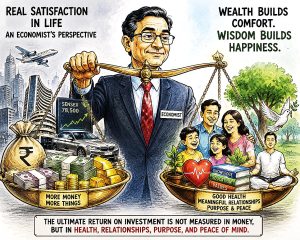
Real Satisfaction in Life: An Economist’s Perspective Beyond Wealth.
While money remains an important factor in improving living standards, many economists argue that real satisfaction extends far beyond financial wealth. The discipline of economics itself offers valuable insights into the relationship between income, happiness, and human well-being.
Beyond Money: Understanding Utility
Economics introduces the concept of “utility”—a measure of the satisfaction or benefit derived from consuming goods and services. However, modern economists increasingly recognize that utility is not solely determined by material wealth.
A person earning a modest but stable income, enjoying good health, meaningful relationships, and a sense of purpose, may experience greater satisfaction than someone with significantly higher earnings but little personal fulfillment.
The Law of Diminishing Happiness
One of the most relevant economic principles in understanding life satisfaction is the Law of Diminishing Marginal Utility. Simply put, the first increase in income can dramatically improve a person’s quality of life by providing food, shelter, healthcare, and education. However, as wealth increases, each additional rupee contributes progressively less to overall happiness.
This explains why many high-net-worth individuals continue to pursue greater wealth while often finding that financial success alone does not guarantee contentment.
What Great Economists Say
The father of modern economics, Adam Smith, believed that prosperity should contribute to a well-functioning and moral society. Nobel laureate Amartya Sen emphasized that true development lies in expanding people’s capabilities and freedoms rather than merely increasing incomes.
Behavioral economists have also demonstrated that people frequently overestimate the happiness that money and possessions can bring while underestimating the value of relationships, experiences, and personal growth.
The New Economics of Well-Being
In recent years, governments and policy-makers worldwide have begun paying greater attention to measures of well-being alongside traditional economic indicators such as GDP. Countries are increasingly examining factors such as health, education, environmental quality, work-life balance, and social trust to assess the quality of life of their citizens.
The growing focus on happiness economics reflects a broader understanding that economic progress should ultimately enhance human welfare.
The Five Pillars of Lasting Satisfaction
According to many economists and social scientists, long-term life satisfaction rests on five key pillars:
- Financial security rather than unlimited wealth.
- Good physical and mental health.
- Meaningful relationships and family bonds.
- Purposeful work that creates value for society.
- Freedom to make choices and pursue personal aspirations.
The Bottom Line
From an economist’s perspective, real satisfaction is not about accumulating endless wealth. It is about achieving a balance where financial resources support a meaningful, healthy, and purposeful life.
As economies grow and societies become more prosperous, the challenge for individuals and policy-makers alike is not merely to create wealth, but to ensure that prosperity translates into genuine well-being.
In the final analysis, true satisfaction may be best defined not by how much one owns, but by how well one lives.
