



Fueling India: How a Handful of States Drive the Nation’s Oil Consumption
New Delhi: India’s growing economy runs on energy, and nowhere is this more evident than in the country’s rising consumption of petroleum products. From bustling metropolitan cities and industrial hubs to vast transportation networks and expanding rural markets, fuel remains the lifeblood of economic activity.
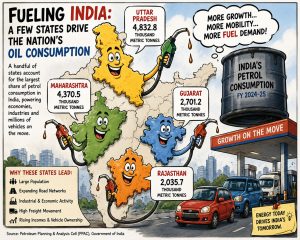
Fueling India: How a Handful of States Drive the Nation’s Oil Consumption.
Recent data on petrol consumption reveals that a few key states account for a substantial share of India’s fuel demand, highlighting their role as engines of economic growth and mobility.
Uttar Pradesh emerged as the country’s largest consumer of petrol during FY 2024-25, recording consumption of nearly 4.83 million tonnes. The state’s massive population, expanding road network, increasing vehicle ownership, and rapid urbanisation have contributed significantly to its growing fuel requirements.
Close behind is Maharashtra, which consumed about 4.37 million tonnes of petrol during the same period. Home to Mumbai, India’s financial capital, and several major industrial centres, Maharashtra’s demand reflects its vibrant economy, extensive logistics operations, and high concentration of vehicles.
Gujarat ranked third with consumption of approximately 2.70 million tonnes. The state is a major manufacturing and industrial hub, housing ports, petrochemical complexes, and extensive freight transportation networks that contribute to sustained fuel demand.
Rajasthan followed with consumption exceeding 2 million tonnes. The state’s growing urban centres, expanding highway infrastructure, tourism sector, and industrial activities have steadily increased its petroleum requirements over the years.
Energy experts note that fuel consumption often serves as a reliable indicator of economic activity. States with higher levels of industrial production, commercial transportation, and urban development tend to record stronger demand for petroleum products.
The trend also reflects changing lifestyles across India. Rising incomes, increased vehicle ownership, improved connectivity, and rapid urban expansion have all contributed to growing fuel consumption. Even smaller cities and semi-urban regions are witnessing a surge in demand as economic opportunities spread beyond traditional metropolitan centres.
However, the increasing appetite for fuel also presents challenges. India imports a significant portion of its crude oil requirements, making the economy vulnerable to fluctuations in global oil prices. Any sharp increase in international crude prices can impact inflation, transportation costs, and household budgets.
To address these concerns, policymakers continue to focus on diversifying energy sources, promoting electric mobility, expanding public transportation, and increasing the use of alternative fuels. The long-term objective is to balance economic growth with energy security and environmental sustainability.
Despite the push towards cleaner energy, petroleum products are expected to remain a critical component of India’s energy mix for the foreseeable future. As the country continues its journey towards becoming a major global economic power, fuel consumption patterns will offer valuable insights into the pace and direction of that growth.
The story of India’s oil consumption is ultimately a story of development, mobility, and aspiration—one that reflects the ambitions of a nation on the move. Forever News – News that Matters
