



Balancing the Scales: India’s Trade Equation in a Shifting Global Order
In the grand ledger of a nation’s economy, few indicators capture both strength and vulnerability as clearly as the trade balance. Defined as the difference between a country’s exports and imports, it is a deceptively simple metric—yet one that carries deep implications for growth, currency stability, and policy direction. For India, the trade balance has once again moved into the spotlight as global uncertainties reshape commerce and supply chains.
At its core, India remains a net importer. From crude oil to electronics and gold, the country’s import bill consistently outweighs its export earnings. This structural trade deficit is not new, but its contours are evolving. In recent months, fluctuations in global commodity prices—especially energy—have had a direct bearing on India’s import costs. When oil prices surge, the deficit widens almost automatically, placing pressure on the rupee and inflating domestic costs.
Exports, on the other hand, tell a more nuanced story. India’s traditional strengths—such as textiles, pharmaceuticals, and engineering goods—continue to hold ground, but they now compete in an increasingly fragmented global market. Demand from key regions like Europe and parts of Asia has shown signs of slowing, while geopolitical tensions have altered trade routes and partnerships. At the same time, services exports, particularly in IT and business process outsourcing, remain a strong cushion, often offsetting part of the goods trade deficit.
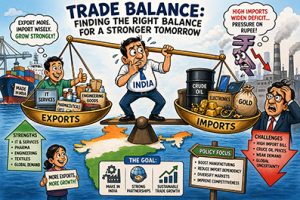
Rising imports, uncertain exports—India’s trade balance walks a tightrope.
Yet, the modern trade balance cannot be viewed in isolation. It is deeply intertwined with currency movements, capital flows, and domestic consumption patterns. A widening trade deficit, for instance, may weaken the rupee, making imports costlier but exports more competitive. However, this theoretical advantage often takes time to materialize and depends heavily on global demand conditions.
Policy responses have grown more strategic. The government has been actively promoting initiatives aimed at boosting domestic manufacturing and reducing import dependency. Schemes focused on electronics, semiconductors, and renewable energy components are designed not just to cut imports but to position India as a global export hub. Trade agreements are also being recalibrated, with an emphasis on securing better market access while protecting sensitive domestic sectors.
There is also a behavioral shift underway among Indian consumers and businesses. The push for “localization” has gained traction, not merely as a slogan but as an economic necessity. However, achieving true import substitution remains a complex challenge, requiring sustained investment, technological advancement, and scale.
The global context adds another layer of complexity. As economies turn more inward and supply chains diversify, India finds itself at both an advantage and a crossroads. The opportunity lies in becoming a preferred alternative in global manufacturing networks. The risk, however, is being caught in the crosscurrents of protectionism and slowing global trade.
Ultimately, the trade balance is less about achieving a surplus and more about managing sustainability. A healthy deficit—one that reflects strong domestic demand and investment—can be a sign of a growing economy. But an unchecked imbalance can strain external finances and policy flexibility.
For India, the path ahead lies in strengthening export competitiveness, diversifying trade partners, and reducing vulnerability to external shocks. In a world where economic equations are constantly being rewritten, keeping the trade balance in check is not just an accounting exercise—it is a strategic imperative.
www.Forevernews.in
