



India’s Detergent Industry: Growth Story, Brand Power & Market Numbers
Mumbai: The detergent industry in India, a quiet but critical pillar of the fast-moving consumer goods (FMCG) sector, is witnessing steady growth driven by rising hygiene awareness, urbanisation, and aggressive brand positioning. What was once a price-sensitive, commodity-driven market has transformed into a highly competitive, brand-led battleground.
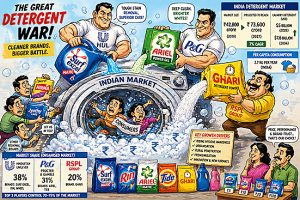
India detergent market brand competition is growing at 7% CAGR.
India’s detergent market has grown into a sizeable industry, valued at around ₹42,800 crore in 2019 and projected to reach nearly ₹73,600 crore by 2027, expanding at a steady 7% CAGR. This growth is supported by increasing disposable incomes, deeper rural penetration, and a shift toward branded and premium products.
In dollar terms, the laundry detergent segment alone stood at about $5 billion in 2025, expected to touch $7.6 billion by 2034, reflecting sustained consumption demand across urban and semi-urban India.
From Powder to Premium: Changing Consumption Patterns
Powder detergents continue to dominate, accounting for nearly 48.5% of the market share, largely due to affordability and widespread use across income segments. However, the fastest growth is now coming from liquid detergents and premium categories, driven by rising washing machine penetration and evolving consumer preferences.
Per capita detergent consumption in India remains relatively low at around 2.7 kg annually, compared to much higher levels in developed markets, indicating significant headroom for growth.
Brand Power: The Real Game Changer
The Indian detergent market is highly concentrated, dominated by a few large players with strong brand recall and distribution networks.
- Hindustan Unilever Limited leads with around 38% market share, powered by brands like Surf Excel, Rin, and Wheel
- Procter & Gamble follows with nearly 31% share, driven by Ariel and Tide
- RSPL Group holds about 20% share with its popular value brand Ghari
- Other players include Nirma Limited, Jyothy Laboratories, and regional brands
Together, the top three players control nearly 70–75% of the organised market, highlighting the dominance of branding, advertising, and distribution muscle.
Brand Projection: Advertising, Pricing & Rural Reach
Detergent brands in India are not just selling cleaning products—they are selling aspirations. From “whiteness” to “tough stain removal,” marketing campaigns have played a decisive role in shaping consumer perception.
Key strategies include:
- Mass advertising: Heavy TV and digital campaigns targeting households
- Price segmentation: From ₹5 sachets to premium liquid detergents
- Rural penetration: Smaller pack sizes and aggressive distribution
Rural India, which accounts for over 65% of the population, is emerging as the biggest growth driver, with rising demand for branded products replacing unorganised alternatives.
The Challenge: Price Wars & Raw Material Pressure
Despite strong growth, the industry faces challenges. Price sensitivity remains high, especially in rural markets, where low-cost local brands still dominate. Additionally, volatility in raw material costs—particularly chemicals like LABSA—has put pressure on margins, especially for smaller manufacturers.
The Road Ahead
The future of India’s detergent industry lies in premiumisation and innovation. Liquid detergents, eco-friendly formulations, and specialised products are expected to drive the next phase of growth. At the same time, digital retail and e-commerce are opening new channels for brand expansion.
Conclusion
India’s detergent industry is no longer just about cleaning clothes—it is about branding, scale, and strategy. With a market heading toward ₹70,000+ crore, dominated by a few giants but challenged by nimble regional players, the sector reflects the broader transformation of India’s FMCG landscape.
In this battle of foam and fabric, the winners will not just be those who clean better—but those who sell smarter.
www.forevernews.in
