



India’s Investment Map Shifts: Which State Leads the Race?
Mumbai: India’s economic momentum is increasingly being shaped not by one dominant region, but by a dynamic competition among states eager to attract capital. The numbers underline the scale of opportunity. India attracted nearly $71 billion in foreign direct investment (FDI) in FY 2023–24, taking cumulative inflows past the $1 trillion mark over the last two decades. Yet, this investment is not evenly spread—it is concentrated among a handful of high-performing states.
At the forefront remains Maharashtra, the country’s financial nerve centre. The state alone accounts for roughly 30–31% of India’s total FDI inflows, translating into an estimated $20–22 billion annually. Backed by Mumbai’s dominance in banking, financial services, and capital markets, Maharashtra continues to be the first port of call for large investors seeking scale and stability.
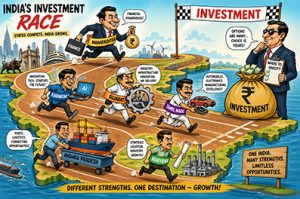
India’s Investment Map Shifts.
Close behind is Karnataka, powered by Bengaluru’s technology ecosystem. The state attracts around 18–20% of FDI, or approximately $12–14 billion each year, driven by strong inflows into IT services, startups, artificial intelligence, and research and development. For investors focused on innovation and future-ready sectors, Karnataka offers a compelling proposition.
For manufacturing-led investments, Gujarat stands out with a consistent 8–10% share of FDI, amounting to about $6–8 billion annually. Known for its industrial efficiency and policy stability, Gujarat continues to draw investments in energy, chemicals, and large-scale manufacturing, while also positioning itself in emerging sectors such as semiconductors.
Southern industrial strength is further reinforced by Tamil Nadu, which contributes around 5–7% of FDI inflows, or roughly $4–6 billion annually. With a strong base in automobiles, electronics, and export-oriented industries, the state has built a robust manufacturing ecosystem supported by skilled labour and established supply chains.
In northern India, Haryana has emerged as a key investment destination, accounting for about 4–5% of FDI, or $3–4 billion annually. Its proximity to the national capital and the rapid growth of the Gurugram-Manesar industrial belt have made it a preferred hub for corporate offices, manufacturing, and research facilities.
Meanwhile, Andhra Pradesh is steadily gaining ground with a 2–3% share of FDI, attracting around $1.5–2.5 billion annually. The state is leveraging its strong port infrastructure and logistics capabilities to position itself as a future-ready industrial and trade hub.
A Concentrated Yet Expanding Story
A closer look at the data reveals a striking pattern. Maharashtra and Karnataka together account for nearly 50% of India’s total FDI inflows, while the top five states contribute close to 70–75%. This concentration highlights both the strengths of established investment hubs and the challenges faced by emerging regions.
At the same time, large-scale investment commitments across sectors are reshaping the landscape. India is witnessing a pipeline of ₹1–2 lakh crore in semiconductor and electronics investments, alongside ₹3–5 lakh crore in renewable energy projects. Infrastructure development, spanning roads, ports, and logistics, is expected to see investments exceeding ₹10 lakh crore in the coming years, creating new opportunities beyond traditional centres.
A Matter of Fit, Not Just Rank
The idea of a single “best” state for investment is rapidly fading. Instead, the choice depends on sectoral alignment:
- Maharashtra for finance and capital-intensive sectors
- Karnataka for technology and startups
- Gujarat and Tamil Nadu for manufacturing and exports
- Andhra Pradesh for logistics and infrastructure
- Haryana for industrial and corporate expansion
The Road Ahead
India’s investment story is evolving into a multi-centre growth model. While capital continues to flow heavily into established leaders, emerging states are building their own ecosystems to attract the next wave of investments.
For investors, the takeaway is clear: India is no longer a one-market destination. It is a federation of competing economic engines, where opportunity lies not just in scale, but in selecting the right geography for the right sector.
www.forevernews.in
