

Monsoon 2026 Warning: El Niño Shadow Looms Over India’s Rainfall Outlook
Mumbai: Monsoon 2026 Warning: El Niño Shadow Looms Over India’s Rainfall Outlook India’s much-awaited southwest monsoon is already under a cloud of uncertainty, with early forecasts indicating a below-normal rainfall season in 2026, raising concerns for agriculture, inflation, and overall economic stability.
According to the latest projections, the monsoon is expected to deliver around 92% of the Long Period Average (LPA), a level considered below normal. This marks a potential break from the past two years of healthy rainfall and signals a more challenging season ahead.
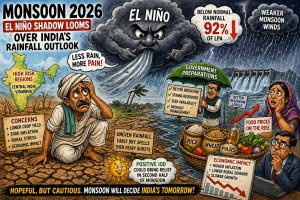
Monsoon 2026 Warning: El Niño Shadow Looms Over India’s Rainfall Outlook.
At the heart of this concern lies the growing likelihood of an El Niño event. Climate models suggest a strong probability of El Niño developing between May and July, a phenomenon historically linked to weaker monsoon winds and reduced rainfall across the Indian subcontinent.
Monsoon 2026 Warning
The implications are significant.
The monsoon contributes nearly 70% of India’s annual rainfall, making it the backbone of agriculture and rural livelihoods. A weaker monsoon could directly impact key crops such as rice, pulses, cotton, and soybeans, potentially reducing yields and pushing food prices higher.
Early regional indicators are already reinforcing concerns. Parts of central India, including regions like Vidarbha, are projected to face below-normal rainfall, with higher probabilities of deficit conditions during the June–September season.
Adding to the complexity is the uneven nature of rainfall expected this year. Experts warn of a mixed pattern—early dry spells followed by erratic bursts of rain, making planning difficult for farmers.
The economic ripple effects could be wide-ranging. A weak monsoon often leads to food inflation, pressure on rural incomes, and slower consumption growth, particularly in agriculture-dependent sectors. At a time when global uncertainties are already high, this adds another layer of risk to India’s growth story.
However, the government remains cautiously optimistic.
Officials have highlighted improved irrigation infrastructure, better reservoir levels, and stronger contingency planning as key buffers against monsoon shocks. From seed availability to drought management strategies, preparations are being ramped up to minimise the impact on farmers and food supply.
There is also a potential silver lining. Weather experts suggest that a positive Indian Ocean Dipole (IOD) later in the season could partially offset the negative effects of El Niño, bringing some relief in the latter half of the monsoon.
For now, the message is clear: 2026 could be a year of cautious optimism mixed with climate risk.
As India prepares for the critical kharif season, the performance of the monsoon will not just determine crop output—it will influence inflation trends, rural demand, and the broader economic trajectory.
In a year already shaped by global uncertainty, the monsoon may once again prove to be India’s most decisive economic variable.
www.forevernews.in