



Forever News
Mumbai Housing Crisis Deepens: 16,400 Applicants Compete for Just 2,640 Affordable Homes
Demand Surge Exposes City’s Growing Urban Inequality
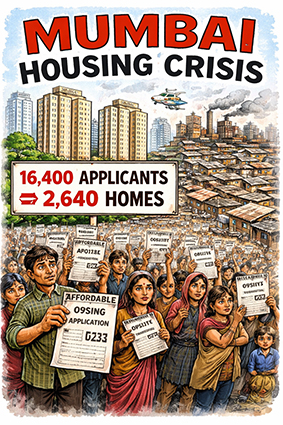
Mumbai: In a stark reflection of Mumbai’s deepening housing crisis, over 16,400 applicants have competed for just 2,640 affordable homes, highlighting the widening gap between demand and supply in India’s financial capital.
The overwhelming response to the latest affordable housing scheme has once again underscored a reality urban planners have long warned about—Mumbai’s housing demand is far outpacing its ability to provide for its residents.
Mumbai housing crisis worsens as 16,400 applicants compete for just 2,640 homes. Here’s what it means for affordability and urban inequality.
A City Where Housing Remains Out of Reach
For millions living and working in Mumbai, owning a home remains an increasingly distant dream. With property prices among the highest in the country, even middle-income families are finding it difficult to secure affordable housing.
The numbers tell a compelling story. With demand exceeding supply by more than six times, the latest housing allocation process has effectively become a lottery, leaving thousands without viable options.
This shortage is not just a matter of real estate—it is a structural issue tied to urban migration, land scarcity, and policy bottlenecks.
The Slum Connection: A Symptom of the Crisis
The housing crunch directly feeds into the expansion of informal settlements across the city.
Areas like Dharavi continue to grow as migrants and low-income workers turn to slums as their only viable housing option. These settlements, while often viewed as a problem, are in fact a response to the city’s inability to provide affordable alternatives.
As demand for housing rises, so does the pressure on already dense slum clusters, intensifying challenges related to sanitation, infrastructure, and public health.
Why Supply Is Falling Behind
Several factors are contributing to Mumbai’s persistent housing shortage.
Land availability remains a critical constraint in a city where space is at a premium. Regulatory hurdles and high construction costs further slow down the pace of new housing development. Additionally, many affordable housing projects struggle with financial viability, discouraging private sector participation.
Urban experts argue that the current model of development is unable to keep up with the scale of demand, particularly from lower and middle-income groups.
Rising Demand Driven by Migration and Aspirations
Mumbai continues to attract people from across India, drawn by employment opportunities and the promise of a better life. However, this steady influx has put immense pressure on the city’s housing infrastructure.
For many migrants, the choice is stark—either live in cramped, informal settlements or face long commutes from distant suburbs where housing is marginally more affordable.
This dynamic has created a cycle where economic opportunity exists, but access to dignified living conditions remains limited.
Impact on Economy and Livability
The housing shortage is not just a social issue—it has direct economic implications.
High living costs reduce disposable income, affecting consumption patterns. Long commutes and overcrowded living conditions impact productivity and quality of life. For businesses, this translates into challenges in attracting and retaining talent.
As Mumbai positions itself as a global financial hub, these structural issues risk undermining its competitiveness.
Policy Challenges and the Road Ahead
Government-led affordable housing initiatives have made some progress, but the scale of the challenge remains immense. Experts suggest that a multi-pronged approach is needed to address the crisis effectively.
This includes accelerating project approvals, incentivising developers, expanding rental housing models, and upgrading existing informal settlements rather than displacing them.
Without sustained and coordinated efforts, the gap between housing demand and supply is likely to widen further.
A Defining Moment for Mumbai
The latest housing data is more than just a statistic—it is a warning signal.
Mumbai stands at a critical juncture where its growth story is increasingly at odds with its urban realities. The city’s ability to address its housing crisis will play a decisive role in shaping its future—not just as India’s financial capital, but as a livable, inclusive global city.
