



Forever News
Mumbai’s Slums: The Invisible Engine Behind a Financial Giant
A Tale of Two Cities
In Mumbai, the morning skyline tells one story, and the streets below tell another.
Glass towers reflect ambition, capital, and global integration. Just a few kilometres away, narrow alleys pulse with human density, enterprise, and survival. In places like Dharavi, where nearly a million people live within a few square kilometres, the city’s contradictions become impossible to ignore.
Mumbai is not merely a financial capital—it is a city balancing two parallel economies, one formal and celebrated, the other informal and overlooked.
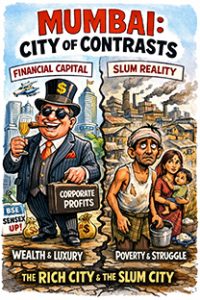
Mumbai’s Slums: The Invisible Engine Behind a Financial Giant.
The Economy No One Accounts For
Walk through Dharavi, and what appears chaotic at first glance quickly reveals itself as highly organised.
Workshops hum with activity—leather goods being stitched, plastic waste sorted and recycled, garments prepared for markets far beyond India. This is not just a settlement; it is a production hub. Estimates suggest that this single cluster generates up to a billion dollars annually.
Across Mumbai, millions living in slums form the backbone of the city’s workforce. They build its infrastructure, run its services, clean its homes, and keep its supply chains moving. The financial capital runs, in many ways, on the strength of those who remain outside its formal systems.
And yet, this contribution rarely finds a place in official economic narratives.
Half the City, Half the Opportunity
Slum Population Share≈ 42% vs Formal GDP Contribution ≈ 10%−15%
This imbalance defines Mumbai’s structural challenge.
Nearly half the population lives in slums, but their contribution to the formal economy remains disproportionately low—not because of lack of effort, but because of lack of access. Limited infrastructure, informal employment, and absence of financial inclusion keep a vast segment of the population economically under-leveraged.
What Mumbai calls a “slum problem” is, in reality, an untapped productivity opportunity.
The Weight of Density
Density in Mumbai is not just a statistic—it is a lived reality.
In Dharavi, space is so scarce that homes double as factories, and streets double as marketplaces. This intense compression places enormous strain on infrastructure. Water supply systems are stretched, sanitation struggles to keep pace, and transport networks are perpetually overloaded.
For businesses operating in Mumbai, these inefficiencies translate into tangible costs—longer commute times, reduced worker productivity, and increased operational uncertainty.
The city’s economic engine continues to run, but not at its full potential.
Land That Cannot Breathe
Perhaps the most striking paradox lies in how Mumbai uses its land.
Some of the most valuable urban real estate in the country is occupied by settlements that generate minimal formal economic output per square kilometer. Dharavi sits strategically close to key business districts and transport hubs, yet remains locked in a low-productivity cycle.
If redeveloped effectively, such land could transform Mumbai’s economic capacity. But redevelopment is not merely a technical exercise—it is a deeply human challenge involving livelihoods, identity, and trust.
A Global City with a Local Constraint
Mumbai aspires to stand shoulder to shoulder with global financial centres like New York City and London.
Yet, the visible coexistence of extreme wealth and widespread informality creates a perception gap. For global investors and institutions, infrastructure readiness and urban stability are as critical as financial metrics.
Mumbai’s story is compelling, but incomplete.
It is a city of immense promise, still negotiating its structural realities.
Why Slums Persist
The persistence of slums is not accidental—it is systemic.
Housing in Mumbai remains prohibitively expensive for a large portion of its workforce. Migration from across India continues to fuel demand, while formal housing supply struggles to keep pace. In this gap, slums emerge not as anomalies, but as solutions—self-built, self-sustained, and self-regulated.
They exist because the city needs them.
The Policy Dilemma
Efforts to address slums have often oscillated between redevelopment and removal. But both approaches face resistance.
For residents, relocation can mean losing proximity to work and dismantling fragile economic networks. For developers, projects are often financially and logistically complex. For governments, the scale of the challenge is immense.
The result is a policy stalemate—where intentions are clear, but execution remains elusive.
Rethinking the Future
Mumbai does not need to erase its slums. It needs to rethink them.
Upgrading infrastructure within existing settlements, integrating informal businesses into the formal economy, and expanding affordable housing options could gradually transform these areas without destroying their economic value.
The goal is not displacement, but evolution.
The Defining Question
Mumbai’s slums are often seen as a symbol of its limitations. But they are equally a testament to its resilience and adaptability.
They power the city, even as they constrain it.
As Mumbai looks ahead, its future will depend on how it resolves this paradox—how it bridges the gap between informality and aspiration, between survival and growth.
Because the real challenge is not whether Mumbai can remain India’s financial capital.
It is whether it can become a truly global one—without leaving half its city behind.
