

Forever News
Resilient Threads: India’s Textile Industry Navigates a Turbulent 2025–26
India’s textile and apparel industry, one of the country’s oldest and most employment-intensive sectors, weathered a challenging global environment in 2025–26 with notable resilience. Despite headwinds ranging from weak demand in key Western markets to logistical disruptions and pricing pressures, the sector managed to hold its ground—underscoring both its structural strength and its evolving global relevance.
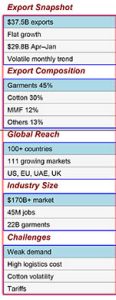
Exports, the lifeblood of the industry, remained broadly stable through the year. After a strong recovery phase in the previous cycle, India’s textile and apparel shipments plateaued at around $37–38 billion in 2025, reflecting a marginal slowdown rather than a sharp decline. The financial year itself was marked by volatility: months of contraction were interspersed with brief rebounds, revealing the fragility of global demand as inflationary pressures persisted across the US and Europe.
Yet, beneath this uneven surface lies a story of transition. The composition of exports is gradually shifting. Traditional cotton textiles, long the backbone of India’s export basket, are now sharing space with value-added segments such as ready-made garments, man-made fibre (MMF) products, and technical textiles. Garments, in particular, showed relative resilience, while segments like handicrafts and MMF yarns posted modest growth—signalling a slow but steady move up the value chain.
Equally significant has been India’s push toward market diversification. No longer overly reliant on a handful of destinations, exporters have expanded their footprint across more than 100 countries. While the United States and European Union remain critical markets, increasing engagement with regions such as the Middle East and emerging economies has helped cushion demand shocks. This strategy, though still evolving, has added a layer of stability in uncertain times.
Domestically, the industry continues to play a pivotal role in India’s economic fabric. Employing over 45 million people, it remains a cornerstone of rural livelihoods and MSME activity. With an estimated market size exceeding $170 billion, the sector is central to India’s manufacturing ambitions, even as it grapples with rising input costs and supply chain inefficiencies.
However, the year has also exposed persistent vulnerabilities. High tariffs in key markets, fluctuating cotton prices, and dependence on imported synthetic fibres have weighed on competitiveness. Global geopolitical tensions have further complicated logistics, pushing up freight costs and delaying shipments. For many exporters, particularly smaller players, these pressures have squeezed margins and heightened uncertainty.
Policy support has provided some relief. Government initiatives, including production-linked incentives and export promotion measures, have begun to encourage investment in scale and technology. Meanwhile, the anticipated benefits of new trade agreements could enhance market access and level the playing field against competitors such as Bangladesh and Vietnam.
Looking ahead, cautious optimism prevails. A gradual recovery in global retail demand, coupled with supply chain realignments away from China, presents a window of opportunity for Indian exporters. The real test, however, will lie in sustaining competitiveness—through cost efficiency, innovation, and a decisive pivot toward high-value, sustainable products.
In many ways, 2025–26 has been a year of consolidation rather than expansion for India’s textile industry. It has demonstrated endurance in the face of adversity, but also highlighted the urgency of transformation. The threads of resilience are intact; weaving them into a stronger global fabric will define the industry’s next chapter.