

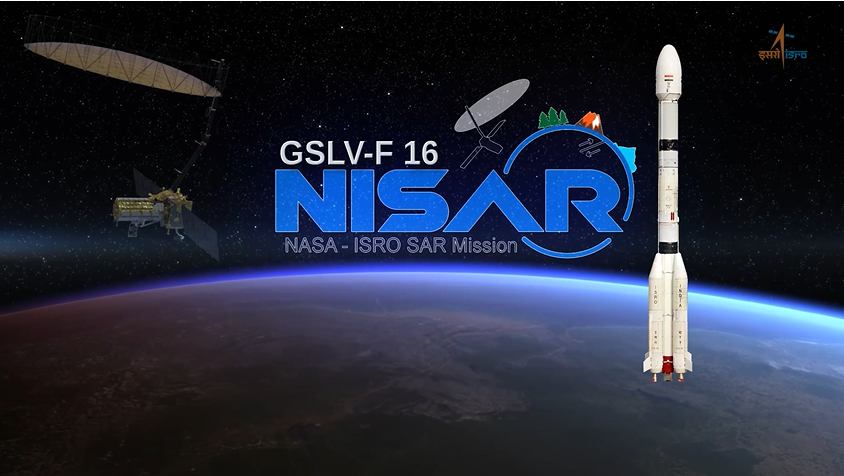
The upcoming launch of the NASA-ISRO Synthetic Aperture Radar (NISAR) satellite mission from Sriharikota on July 30 is set to redefine international scientific cooperation and elevate India’s stature in global Earth observation. Union Minister Jitendra Singh announced that the mission, scheduled for liftoff at 17:40 hrs aboard India’s GSLV-F16 rocket from the Satish Dhawan Space Centre, represents a landmark in the strategic partnership between the Indian Space Research Organisation and the United States’ National Aeronautics and Space Administration.
Describing NISAR as a global benchmark for Indo-US scientific collaboration, Jitendra Singh said the mission exemplifies the vision of Prime Minister Narendra Modi for India to become a ‘Vishwa Bandhu’—a global partner contributing to the collective good of humanity. He emphasized that NISAR is not merely a satellite but a scientific handshake with the world, reflecting the maturity of India’s strategic scientific partnerships and its emergence as a credible global player in advanced Earth observation systems.
The NISAR mission is the first joint Earth observation initiative between ISRO and NASA and marks the first time a GSLV rocket will place a satellite in sun-synchronous polar orbit. The satellite, weighing 2,392 kg, will be positioned to offer repeat imaging of the Earth’s land and ice surfaces every 12 days. NASA has contributed the L-Band Synthetic Aperture Radar, a high-rate telecommunication subsystem, GPS receivers, and a 12-meter deployable unfurlable antenna. ISRO has provided the S-Band SAR payload, the spacecraft bus to accommodate both payloads, the GSLV-F16 launch vehicle, and all associated launch services.
Jitendra Singh noted that the mission has been in development for over a decade and represents a joint investment exceeding $1.5 billion, or approximately Rs 125 billion. He said the launch is being closely monitored by space agencies, environmental researchers, and policymakers worldwide due to its transformative potential in global utility and technological advancement.
From an applications perspective, NISAR will offer critical data for disaster management, agriculture, and climate monitoring. It will enable continuous monitoring of ecosystem disturbances and assess natural hazards such as earthquakes, tsunamis, volcanic eruptions, and landslides. The satellite will detect even subtle changes in the Earth’s crust and surface movement. It will also support sea ice classification, ship detection, shoreline monitoring, storm tracking, crop mapping, and changes in soil moisture. These capabilities are vital for governments, researchers, and disaster management agencies across the globe.
A key feature of the mission is the democratization of data. All data generated by NISAR will be made freely accessible within one to two days of observation, and in near real-time during emergencies. This open-access model is expected to support global scientific research and decision-making, particularly for developing countries that lack similar capabilities.
The satellite’s dual radar payload will employ SweepSAR technology, enabling high-resolution, all-weather, day-and-night imaging of the Earth’s surface with a wide swath of 242 kilometres. Jitendra Singh underscored the importance of Earth observation missions in the context of climate resilience and sustainable development, stating that missions like NISAR are essential for planning, risk assessment, and policy intervention as climate change impacts intensify.
He expressed his desire to be present at Sriharikota to witness the historic launch but acknowledged that the ongoing Parliament session may require him to remain in Delhi. He reiterated that India’s space programme under Prime Minister Modi is transitioning from traditional utility-based missions to those that position the country as a knowledge contributor to the global commons.
Jitendra Singh concluded by affirming that NISAR is a symbol of what two democracies committed to science and global welfare can achieve together. The mission stands as a testament to India’s growing technical sophistication and its role in shaping the future of Earth observation and international scientific collaboration.