
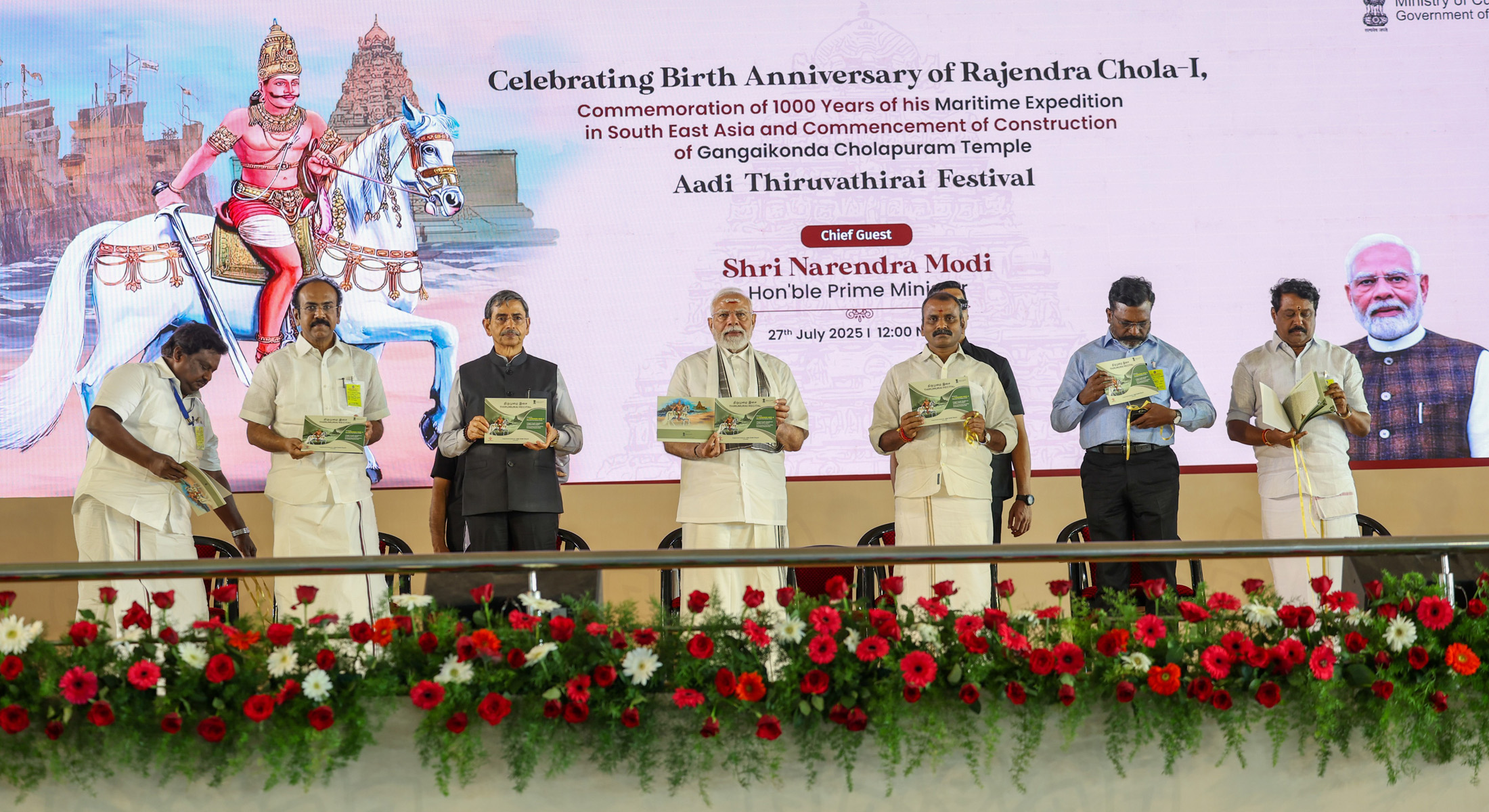
Prime Minister Narendra Modi addressed the Aadi Thiruvathirai Festival at the historic Gangaikonda Cholapuram Temple in Tamil Nadu, marking a momentous celebration of India’s cultural and spiritual heritage. The event commemorated 1,000 years since the construction of the Brihadeeswarar Shiva Temple and the legendary maritime expedition of Rajendra Chola I to Southeast Asia. The Prime Minister released a commemorative coin in honour of Rajendra Chola I, one of India’s greatest emperors, and paid tribute to the enduring legacy of the Chola dynasty.
Bowing to Lord Shiva, Modi described the spiritual energy of the land as deeply moving, enriched by the divine Shiva Darshan, the music of Ilaiyaraaja, and the sacred chanting of the Odhuvars. He performed worship at the Brihadeeswarar Temple, praying for the welfare of 140 crore Indians and the continued progress of the nation. He urged citizens to visit the exhibition on 1,000 years of history curated by the Union Ministry of Culture, showcasing the roadmap laid by India’s ancestors for human welfare and prosperity. He also attended the launch of the Tamil Gita album by the Chinmaya Mission, praising the initiative for energizing the national resolve to preserve heritage.
Modi highlighted the Chola Empire’s diplomatic and trade outreach to Sri Lanka, the Maldives, and Southeast Asia, noting the coincidence of having returned from the Maldives just a day prior. He declared that the legacy of Rajaraja Chola and Rajendra Chola is synonymous with India’s identity and pride, and that the history of the Chola Empire reflects the strength and true potential of the nation. He emphasized that this heritage inspires the national aspiration of building a developed India and paid tribute to Rajendra Chola the Great.
The Prime Minister stated that historians regard the Chola period as one of the golden eras of Indian history, distinguished by formidable military strength and democratic traditions. He cited the Kudavolai Amaippu system as an example of early democratic election practices, predating the Magna Carta. He noted that while many rulers are remembered for acquiring wealth, Rajendra Chola is revered for bringing sacred Ganga water from North India to the South, establishing it in the Chola Ganga Lake, now known as Ponneri Lake. Modi expressed joy that Ganga water has once again been brought from Kashi to Tamil Nadu, with a formal ritual conducted at the site, reinforcing the spirit of Ek Bharat, Shreshtha Bharat.
He remarked that the Chola rulers had woven India into a thread of cultural unity, a vision the current government is carrying forward through initiatives like the Kashi-Tamil Sangamam and the Saurashtra-Tamil Sangamam. He noted that ancient temples such as Gangaikonda Cholapuram are being preserved by the Archaeological Survey of India. Recalling the inauguration of the new Parliament building, Modi highlighted the spiritual leadership of saints from the Shaivite Adheenams and the ceremonial installation of the sacred Sengol, rooted in Tamil tradition.
Modi shared his meeting with Dikshitars from the Chidambaram Nataraja Temple, who presented him with a sacred offering. He noted that the Nataraja form symbolizes India’s philosophy and scientific foundations, and that a similar Ananda Tandava idol adorns Bharat Mandapam in Delhi, where global leaders gathered during the G-20 summit in 2023.
He emphasized the vital role of India’s Shaivite tradition in shaping the nation’s cultural identity, crediting the Chola emperors as key architects of this legacy. Tamil Nadu continues to be a vibrant center of Shaivite heritage, enriched by the devotional literature of the Nayanmar saints and the spiritual influence of the Adheenams. Modi stated that these elements catalyzed a new era in social and spiritual spheres.
Addressing global challenges such as instability, violence, and environmental crises, Modi asserted that Shaivite philosophy offers meaningful solutions. He cited Tirumular’s teaching ‘Anbe Sivam’—Love is Shiva—as a guiding principle for global harmony. He affirmed that India is advancing this philosophy through the motto ‘One World, One Family, One Future’.
Modi declared that modern India is guided by the mantra ‘Vikas Bhi, Virasat Bhi’, and takes pride in its history. He noted that over the past decade, India has worked in mission mode to preserve its cultural legacy, repatriating more than 600 ancient artifacts since 2014, including 36 from Tamil Nadu. He listed heritage items such as Nataraja, Lingodbhavar, Dakshinamurthy, Ardhanarishwara, Nandikeswara, Uma Parameshwari, Parvati, and Sambandar that have returned to adorn the land.
He stated that India’s heritage and Shaiva philosophy are no longer confined to its borders, citing the naming of the lunar site “Shiv-Shakti” after India became the first country to land on the Moon’s South Pole. Modi praised the economic and strategic advancements of the Chola era, noting that Rajaraja Chola built a powerful navy, which Rajendra Chola further strengthened. He highlighted administrative reforms, local governance empowerment, and a robust revenue structure as hallmarks of the Chola period.
Modi asserted that India must prioritize unity, strengthen its navy and defense forces, seek new opportunities, and safeguard its core values to become a developed nation. He cited Operation Sindoor as a testament to India’s decisive response to threats against its sovereignty, stating that the operation sent a clear message that there is no safe haven for terrorists and enemies of the nation. He remarked that Operation Sindoor has instilled new confidence in the people and is being witnessed by the world.
Drawing a parallel to Rajendra Chola’s humility, Modi noted that the gopuram of Gangaikonda Cholapuram was built lower than that of his father’s Brihadeeswarar Temple, despite his achievements. He stated that New India embodies this same spirit—becoming stronger while remaining rooted in values of global welfare and unity.
Modi announced that grand statues of Rajaraja Chola and Rajendra Chola I will be installed in Tamil Nadu, serving as modern pillars of India’s historical consciousness. He noted that the day also marks the death anniversary of former President A. P. J. Abdul Kalam and remarked that India needs millions of youth like Kalam and the Chola kings to lead the nation toward development. He concluded by affirming that youth filled with strength and devotion will fulfill the dreams of 140 crore Indians and advance the resolve of Ek Bharat, Shreshtha Bharat.
The event was attended by revered saints, the Governor of Tamil Nadu R. N Ravi, Union Minister Dr. L Murugan, and other dignitaries.