
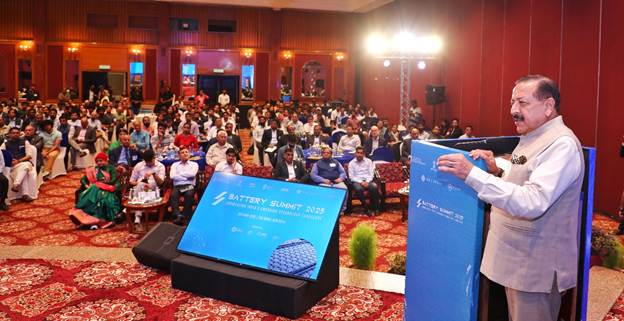
India’s ambitious clean energy transition received a major boost at the Battery Summit 2025, where Union Minister Dr. Jitendra Singh outlined a transformative roadmap for strengthening India’s battery ecosystem, driving economic growth, and achieving the nation’s Net Zero 2070 target.
Highlighting India’s emergence as the world’s fourth-largest economy, Dr. Singh emphasized that innovation in low-carbon technologies and exploration of untapped reserves will be key to propelling India toward the third position. He underscored that leveraging resources such as the recently discovered lithium reserves in Jammu & Kashmir will play a vital role in reducing India’s carbon footprint and supporting sustainable growth.
A major announcement at the summit was the launch of the Battery Aadhaar Initiative, hailed as a “game changer” for India’s battery ecosystem. This initiative, spearheaded by the Department of Science and Technology (DST), will assign unique digital identities to battery packs, enabling tracking of manufacturing origins, battery chemistry, certifications, and lifecycle performance. It will enhance efficiency in predictive maintenance, recycling, and regulatory oversight while curbing the spread of counterfeit products. By integrating AI-driven diagnostics and national EV databases, Battery Aadhaar will become a cornerstone of India’s battery intelligence ecosystem.
Dr. Singh also highlighted several forward-looking initiatives driving India’s clean energy transition, including the Production Linked Incentive (PLI) Schemes for Advanced Chemistry Cells, PM-eDrive, FAME (Faster Adoption and Manufacturing of Electric Vehicles) Schemes, and the MAHA-EV Mission under the Anusandhan National Research Foundation (ANRF). These programs aim to strengthen India’s electric vehicle sector and promote sustainable transportation solutions.
Reflecting on India’s global leadership in climate action, Dr. Singh noted the nation’s remarkable transformation in climate negotiations, shifting from a hesitant participant to a key advocate of sustainability. He credited this evolution to initiatives such as Net Zero 2070, Mission LiFE (Lifestyle for Environment), and the International Solar Alliance (ISA), reinforcing India’s position in global clean energy partnerships.
India’s progress in science and innovation was also a focal point of the summit. Dr. Singh cited India’s rise in the Global Innovation Index—from rank 81 to rank 39—as evidence of its research and development momentum. The country now boasts over 1.7 million startups, making it the third-largest startup ecosystem globally. The DST’s budget has seen a 926% increase, underscoring the government’s commitment to fostering innovation.
Key dignitaries at the summit included Prof. Abhay Karandikar, Secretary of DST, Mr. Asher Lessels from the United Nations Environment Program (UNEP), Dr. Anita Gupta, Head of CEST at DST, and Mr. Madhav Pai, CEO of WRI India. Their presence highlighted the collaborative efforts between academia, industry, and government in advancing clean energy solutions.
Dr. Singh outlined three priority areas for India’s continued leadership in science and energy innovation—technology indigenization to reduce imports, domestic manufacturing growth to create resilient supply chains and employment opportunities, and a robust innovation ecosystem fostering collaborations for scalable solutions.
Acknowledging the contributions of organizations such as WRI India, UNEP, NITI Aayog, and the Global Environment Facility (GEF), Dr. Singh reiterated India’s commitment to sustainable development and clean energy leadership.
The Battery Summit 2025 underscored India’s readiness to lead global innovation in battery technology, electric mobility, and carbon neutrality, setting the stage for the nation’s transformative journey toward a sustainable future.