
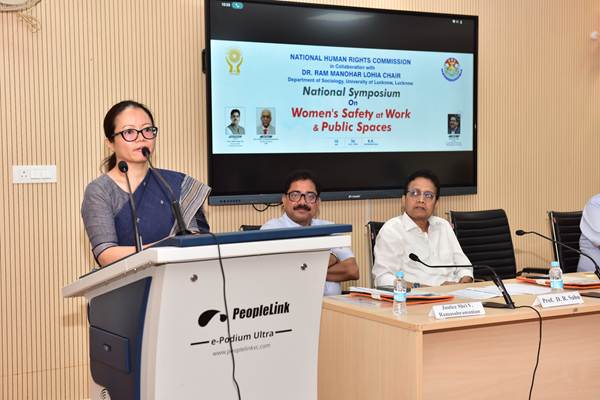
At the second National Symposium on ‘Women’s Safety at Work and Public Spaces’, jointly organised by the National Human Rights Commission and the Dr. Ram Manohar Lohia Chair at the University of Lucknow, women participants and experts voiced a clear and urgent demand for safety, dignity, and structural representation. The event, held on July 26, followed the inaugural symposium in September 2024 and responded to the rising tide of gender-based violence in professional and public domains across India.
NHRC Chairperson Justice V. Ramasubramanian, delivering the keynote address virtually, highlighted the stark contrast between India’s cultural reverence for goddesses and the grim reality of violence against women, citing that nearly 51 FIRs related to such crimes are registered every hour. He recalled the long struggle behind the enactment of the Prevention of Sexual Harassment at Workplace Act, 2013, and emphasized that despite women’s increasing participation in education and careers, systemic reforms are essential to ensure their safety and dignity. He called for stronger enforcement mechanisms and deeper societal awareness.
Smt. Saidingpuii Chhakchhuak, Joint Secretary of NHRC, shared personal experiences to illustrate the persistence of gender-based violence despite legal protections. She stressed that NHRC takes proactive steps to address human rights violations and expressed hope that future generations would be more vocal and action-oriented. She urged educators to be more sensitive to gender issues and emphasized that not all crimes are overtly violent, calling for a comprehensive focus on policy, enforcement, and public awareness.
Prof. S.K. Chowdhury from the University of Lucknow stated that constitutional rights to liberty and equality must be matched by the confidence to report crimes. He called for structural adjustments and a culture of human rights that translates into everyday behaviour. Prof. S.M. Patnaik from the University of Delhi offered a socio-anthropological analysis of harassment in public spaces, explaining how patriarchy and anonymity reinforce gendered violence. Quoting Carl Sagan, he warned against assuming that lack of data indicates the absence of a problem. He advocated for empathy, early gender sensitisation, and robust support systems.
Dr. P.K. Gupta from the University of Lucknow highlighted the prevalence of domestic crimes and stressed the need for behavioural change beginning at the household level. Dr. S.N. Sabat, Chairperson of the Uttar Pradesh Subordinate Services Selection Commission, focused on legal mechanisms and called for investment in emerging technologies and surveillance systems to enhance safety in urban areas.
Prof. Nilika Mehrotra from Jawaharlal Nehru University emphasized the role of public transport systems in ensuring women’s safety and called for context-sensitive solutions. She urged greater sensitivity within law enforcement and the judiciary, rejecting a one-size-fits-all approach.
Throughout the symposium, speakers and participants addressed systemic injustices, gender stereotypes, and institutional inertia that hinder the realization of constitutional guarantees. They stressed the importance of legal awareness, proactive state interventions, and increased representation of women in decision-making bodies. The evolution of human and women’s rights in India and globally was discussed, along with the alignment of Indian constitutional provisions with the Universal Declaration of Human Rights. Existing support mechanisms such as SHE-Box, One Stop Centres, and Pink Police Booths were also highlighted.
Key recommendations emerging from the symposium included the need for targeted efforts across policy-making, implementation, and awareness; inclusion of the informal sector in safety dialogues; sensitisation at individual and family levels; creation of inclusionary spaces for women in governance; and proactive steps by educational institutions to foster gender sensitivity and respectful conduct.
The NHRC reaffirmed its commitment to combating gender-based violence and strengthening institutional collaboration to create safer, more inclusive public and professional spaces for women. The voices of women at the symposium made it clear: safety, dignity, and representation are not optional—they are non-negotiable.