
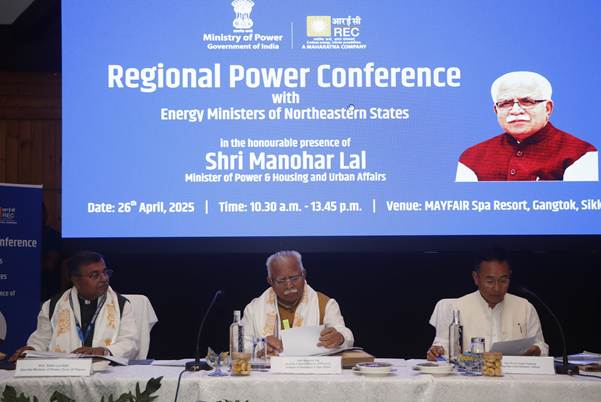
The Regional Conference of the Power Sector convened in Gangtok, bringing together ministers, officials, and industry leaders to address the challenges and opportunities in the power sector across North Eastern states. Union Minister of Power and Housing & Urban Affairs, Manohar Lal, emphasized the need for a future-ready, modern, and financially viable power sector as India progresses toward becoming a developed nation.
Acknowledging the essential role of electricity in achieving economic growth, he highlighted that despite a marginal gap of 0.1% in meeting current power demands, the focus must remain on future requirements. Since 2014, power generation has increased significantly across thermal, hydro, atomic, and renewable sources. Addressing environmental concerns and advancing non-fossil energy is crucial to achieving India’s Net Zero Emissions target.
Manohar Lal outlined key challenges facing the distribution sector, including poor tariff structures, inefficient billing and collection systems, and delays in government payments and subsidies. He stressed that reducing aggregate technical and commercial losses and closing the gap between the average cost of supply and revenue realized are fundamental to making the sector sustainable. Cost-reflective tariffs and effective execution of Smart Metering Works under RDSS will help utilities improve operational efficiency. He urged states to prioritize prepaid smart metering for government establishments, including government colonies.
The conference also focused on maximizing the hydro-power potential of the region, including pumped-storage facilities. The Secretary of Power underscored the importance of capital infusion for meeting growing electricity demands and driving reforms. He stressed the need for early planning to secure power supply through resource adequacy frameworks extending up to 2030, calling for strategic intra-state transmission capacity development through mechanisms such as Tariff-Based Competitive Bidding, Regulated Tariff Mechanism, budgetary support, and asset monetization.
The Chief Minister of Sikkim welcomed attendees and detailed ongoing efforts to enhance power reliability and quality in the state. He outlined proposed improvements to the sector and sought intervention from the central government on key concerns affecting the region. Ministers and officials from Tripura, Meghalaya, Mizoram, Arunachal Pradesh, and Sikkim participated in discussions, expressing gratitude for the continued emphasis on strengthening power infrastructure in the North Eastern states.
The conference reaffirmed the government’s commitment to fostering a resilient and sustainable power sector, ensuring energy security, and driving economic growth through strategic planning and targeted investments.