
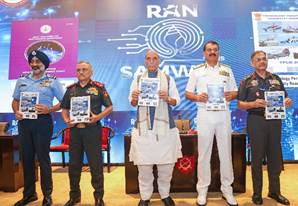
Raksha Mantri Rajnath Singh has released the Joint Doctrine for Multi-Domain Operations and the Technology Perspective & Capability Roadmap at RAN SAMWAD, a tri-service seminar held at the Army War College in Dr Ambedkar Nagar, Madhya Pradesh. Addressing the complexities of modern warfare, he emphasized that mastering existing technologies while preparing for unforeseen innovations is essential to maintaining strategic superiority.
He stated that warfare now extends beyond land, sea, and air into outer space and cyberspace, with satellite systems, anti-satellite weapons, and space command centres becoming instruments of power. Future wars, he said, will be shaped by technology, intelligence, economy, and diplomacy, and the nation that masters the triangle of technology, strategy, and adaptability will emerge as a global power.
Rajnath Singh highlighted the role of surprise and technological fusion in modern conflicts, noting that tools such as unmanned aerial vehicles, hypersonic missiles, cyber-attacks, and AI-driven decision-making are redefining the battlefield. He asserted that India must define the battlefield and its rules to maintain a strategic advantage, citing Operation Sindoor as a successful example of technology-driven warfare.
He praised the Indian Armed Forces for their swift and effective response during Operation Sindoor, which targeted terrorist hideouts in Pakistan. The operation demonstrated the importance of jointness, integration, and robust cyber infrastructure. He also commended the Army’s initiative to train all jawans in drone technology by 2027 and the formation of specialized units such as Rudra Brigade, ShaktiBaan Regiment, Divyastra Battery, Drone Platoon, and Bhairav Battalion.
The Raksha Mantri reiterated the government’s commitment to Aatmanirbhar Bharat, noting that indigenous platforms like Tejas, Akash Missile System, Advanced Towed Artillery Gun System, and the Indigenous Aircraft Carrier have reached world-class standards. He announced progress in developing fifth-generation fighter aircraft and jet engines within India.
India’s defence production has reached a record Rs 1.5 trillion in FY 2024–25, up from Rs 464.25 billion in 2014. Defence exports have surged to Rs 24,000 crore from less than Rs 1,000 crore a decade ago. These achievements reflect India’s transformation from a major importer to a reliable exporter of defence equipment.
The Sudarshan Chakra Mission, announced by the Prime Minister, aims to shield vital locations with indigenously developed technology. Rajnath Singh also referenced DRDO’s successful tests of the Integrated Air Defence Weapon System and a high-powered Directed Energy Weapon.
He affirmed that the Indian Navy is being strengthened to meet evolving threats, citing its strategic positioning during Operation Sindoor. The Navy’s presence in the Indian Ocean ensures maritime security and supports national economic interests. The Indian Air Force is also being enhanced with long-range missiles, next-generation weapons, and a fortified Counter Unmanned Aerial Systems Grid.
Rajnath Singh stressed that national security now requires a whole-of-nation approach, involving industry, academia, media, and civil society. He called for continuous strengthening of the domestic defence industry to ensure preparedness for prolonged conflicts. He concluded by affirming India’s commitment to peace and justice, while asserting readiness to defend its sovereignty with strength and resolve.
The Joint Doctrine for Multi-Domain Operations outlines integrated employment of the Armed Forces across land, sea, air, space, cyber, and cognitive domains. The Technology Perspective & Capability Roadmap provides a ten-year modernization plan, guiding industry and R&D institutions to align with national defence needs and reduce import dependence.