
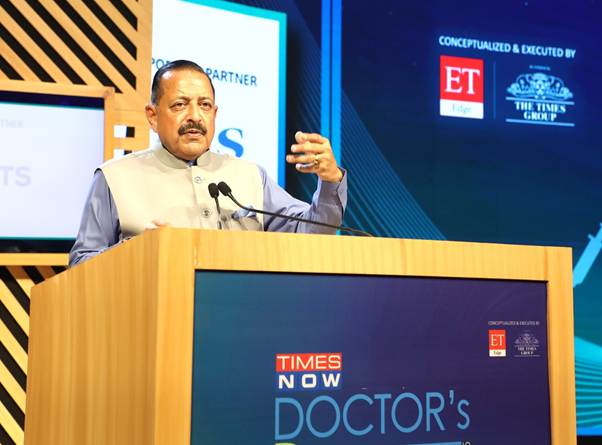
India is on the cusp of a transformative health-tech revolution, Union Minister Jitendra Singh declared at the ET Times Now Doctor’s Day Conclave, describing an era shaped by medical innovation, demographic change, and global leadership in preventive care. Citing India’s leap from the tenth to the fourth largest global economy, the Minister said this ascent coincides with a turning point in India’s healthcare narrative—where cutting-edge technology meets ancient ethos to define a futuristic and inclusive ecosystem for Viksit Bharat 2047.
Singh celebrated the upcoming space mission of astronaut Shubhanshu Shukla to the International Space Station carrying indigenous life science kits, calling it a precursor to the birth of a new medical discipline: space medicine. “Very soon, we might have a dedicated stream in medical academics called Space Physicians,” he said. He underscored the significance of this moment, noting that India is one of the few countries poised to shape such a frontier discipline through indigenous capability.
Addressing India’s demographic dynamics, Singh spoke of a bi-phasic challenge—managing a growing elderly population due to rising life expectancy alongside a vast youth segment with over 70 percent of the population under age 40. Life expectancy, once 50–55 years in 1947, is now approaching 80. This, he said, mandates systemic readiness for both geriatric care and innovation for youthful communities.
Singh also addressed the dual disease burden Bharat faces: the simultaneous prevalence of communicable and non-communicable illnesses, amplified in the post-COVID era. He called for greater use of mass screening, early detection, and preventive healthcare, urging deeper integration of AI, machine learning and telemedicine into both urban and rural medical infrastructure.
Highlighting major achievements, he noted India’s pioneering role in developing the world’s first DNA vaccine for COVID-19 and an HPV vaccine to prevent cervical cancer. He revealed that India had also successfully conducted its first gene therapy trial for haemophilia, with findings published in the New England Journal of Medicine. He announced the launch of Nafithromycin, India’s first indigenously developed antibiotic molecule, marking a milestone in pharmaceutical innovation.
He attributed these breakthroughs to early-stage collaboration between the government and private sector, stating that the success of India’s healthcare transformation hinges on seamless integration from the research bench to clinical rollout.
The Minister welcomed the establishment of new medical schools at IIT Kanpur and IISc Bengaluru, calling such cross-disciplinary institutional innovation critical for shaping holistic models of science-based healthcare. He praised institutions like the Sree Chitra Tirunal Institute in Trivandrum, which integrate research, manufacturing and clinical care, as models for replication.
Singh spotlighted Tata Memorial Centre’s targeted radiation therapy systems and its achievement as a 100 percent digital and cashless hospital. He also recalled sanitation breakthroughs during the Kumbh Mela, where radiation-based faecal sludge treatment plants protected over 400 million pilgrims without causing public health hazards.
On climate-health links, Singh spoke of the newly launched Mission Mausam, an early warning system focused on mitigating health risks during climate-induced disasters. He positioned the initiative as part of India’s preparedness matrix to deal with overlapping crises.
Concluding his address, Singh urged for synergy between academia, research, industry and governance. He advocated institutional innovation, private-public partnerships, and integrated delivery systems to ensure scalability and sustainability. Echoing a deeper message, he said, “Let us not hand over everything to the technocrats. A bit of the doctor must remain. We must carry forward both the science and the soul of medicine.”