
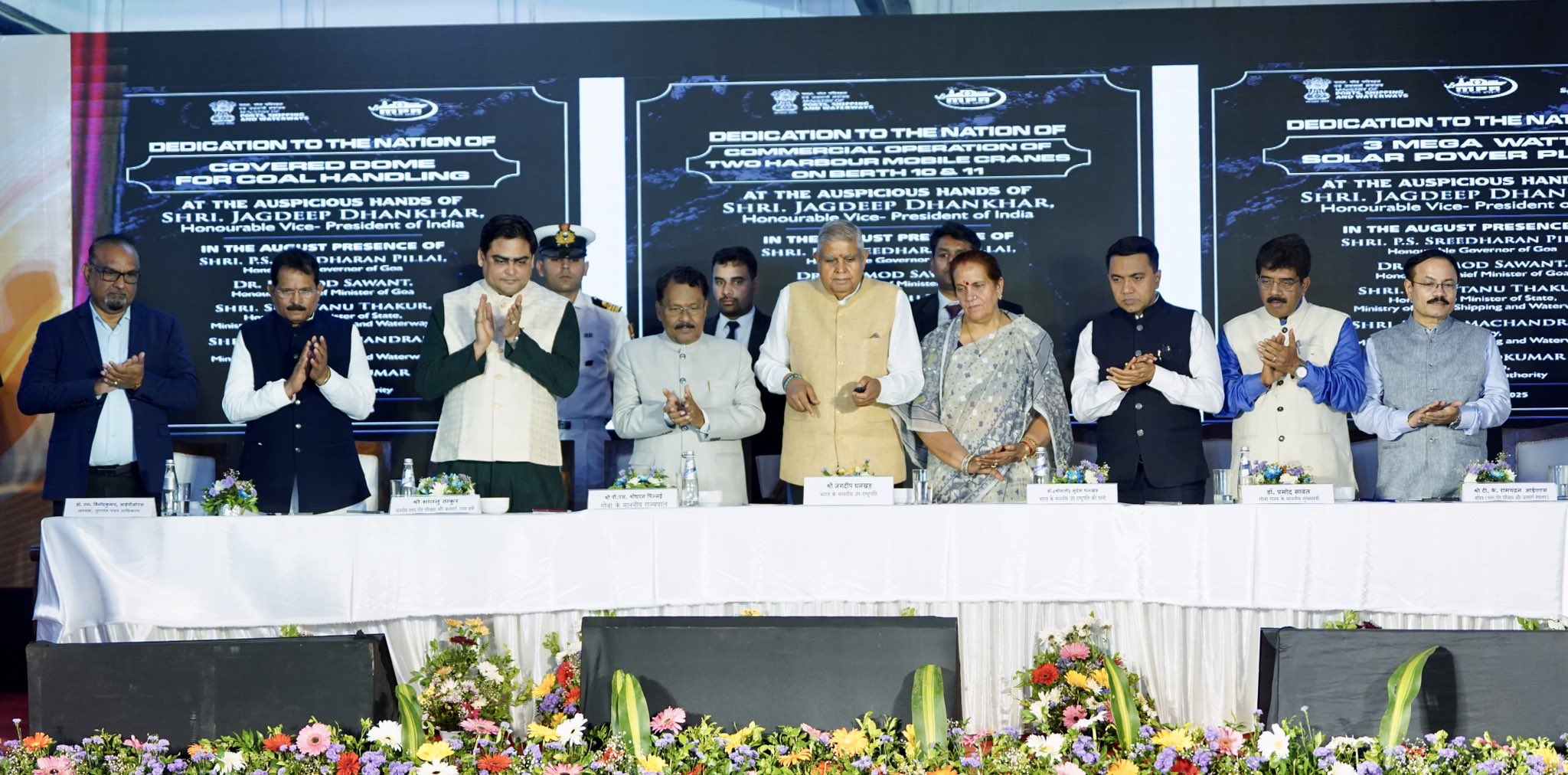
India marked a significant stride towards its maritime and infrastructural modernisation as Vice President Jagdeep Dhankhar inaugurated three critical projects at the historic Mormugao Port in Goa. These projects, with a combined financial outlay of approximately 36 million dollars (about 300 crore rupees), highlight India’s commitment to fast-paced development, environmental stewardship, and economic transformation under the leadership of Prime Minister Narendra Modi.
The Vice President, addressing a distinguished gathering that included Goa Governor P.S. Sreedharan Pillai, Chief Minister Pramod Sawant, Union Ministers Shantanu Thakur and Shripad Naik, and several key officials from the Ministry of Ports, Shipping and Waterways, praised the government’s relentless drive to modernise ports and invigorate India’s maritime economy. He commended the presence and performance of the Indian Coast Guard and declared the event a celebration of India’s resurgence as a global maritime power.
The inaugurated projects include a state-of-the-art three-megawatt solar power plant, a pair of high-capacity harbour mobile cranes at berths 10 and 11, and a covered coal handling dome executed through a public-private partnership with leading corporate house JSW. These developments not only reflect India’s commitment to environmental protection and sustainable energy but also underscore the importance of technological penetration and efficiency in port operations.
Vice President Dhankhar described the solar power plant as a symbol of India’s rapid embrace of renewable energy, recalling that just a decade ago, the country had negligible solar capacity. Today, India stands as a global leader in clean energy with solar installations across the landscape and the International Solar Alliance headquartered in the country.
The commercial deployment of harbour mobile cranes, which the Vice President personally inspected, signals India’s resolve to enhance port productivity and adopt cutting-edge technology. The cranes will significantly improve cargo handling speeds and reduce turnaround times for vessels.
He particularly highlighted the significance of the covered coal handling dome as a breakthrough in environmentally responsible infrastructure. Built in collaboration with JSW, the dome minimises dust pollution and stands as a model of how public-private partnerships can foster sustainable industrial growth.
Mormugao Port, one of India’s oldest and most strategic maritime gateways, holds immense historical importance, dating back to the Indus Valley civilisation. In his speech, the Vice President paid tribute to Goa’s rich maritime traditions and seafaring legacy, calling them a source of pride for the state and the nation. He also praised the exemplary hosting of the 37th National Games in Goa, showcasing the state’s management acumen and athletic spirit.
Turning his attention to maritime security, the Vice President saluted the Indian Coast Guard, describing it as a force that is not only operationally strong but morally driven. He lauded their role in saving lives during cyclones and disasters, especially citing his experience as Governor of West Bengal, a region frequently hit by devastating storms. He praised the Coast Guard’s role in thwarting smuggling and infiltration, and emphasised their integral contribution to the nation’s maritime security.
Dhankhar referenced India’s firm response to Pakistan-based terrorist organisations like Jaish-e-Mohammed and Lashkar-e-Taiba following the April 22 Pahalgam attack, asserting that the world had taken note of India’s precise and effective counterstrike on terrorist infrastructure in Muridke and Bahawalpur. He described Operation Sindoor as a historic success that silenced doubters and sent a clear global message that terrorism will be punished with resolve.
He underscored the growing importance of the blue economy, stressing that the Indian Coast Guard plays a pivotal role in enabling its evolution. With over 7,500 kilometers of coastline, India’s marine zones are rich in resources and strategic significance. He urged the nation to harness the full potential of its oceanic wealth, including offshore oil platforms, fishery zones, and undersea mineral deposits, all of which are vital to energy security and economic growth.
Beyond defence, he lauded the Coast Guard’s role in environmental protection—guarding coral reefs, mangroves, and marine biodiversity, while acting against illegal fishing, oil spills, and toxic maritime pollution. He called them the protectors not just of national waters but of Mother Earth’s ecological lungs.
The Vice President stressed that in today’s shifting geopolitical climate—where cyber threats, strategic chokepoints, and global trade routes intersect—India’s maritime security must be proactive, resilient, and future-ready. He praised the Coast Guard’s increasing surveillance capabilities, enhanced air-sea coordination, and commitment to enforcing rules-based order at sea.
In praising the leadership of Mormugao Port, Dhankhar stated that Indian ports must strike a balance between commerce and environmental responsibility. He placed particular emphasis on the government’s Sagarmala vision, which seeks to fully unlock the potential of India’s coastlines and transform them into thriving hubs of trade and development. He said India’s ports are no longer merely logistical facilities but bridges connecting Bharat to the world.
The Vice President also noted the recent inauguration of a new port in Kerala, a landmark in cooperative federalism where the central government, a state government of a different political party, and the private sector came together for a common goal. He pointed to the increasing importance of shipbuilding and urged stakeholders to ensure India becomes a leader in that domain as well. With 95% of cargo by volume and 70% by value transported through maritime routes, he predicted exponential demand in the sector, driven by the country’s quantum leap in economic growth.
Calling for national unity on developmental priorities, he urged political leaders and citizens to support infrastructure investments in ports, airports, and shipyards without falling into partisan disputes. Development, he said, must rise above political lines.
He concluded his address with a tribute to the Indian Coast Guard, expressing confidence in their continued vigilance, valor, and victory. He reiterated the government’s unwavering commitment to modernising the maritime sector, strengthening coastal defence, and unlocking the economic potential of India’s vast maritime domain.
As India aims to become a developed nation—Viksit Bharat—by 2047, the integration of modern infrastructure, robust security, and ecological sensitivity at ports like Mormugao will be a cornerstone of its journey.