

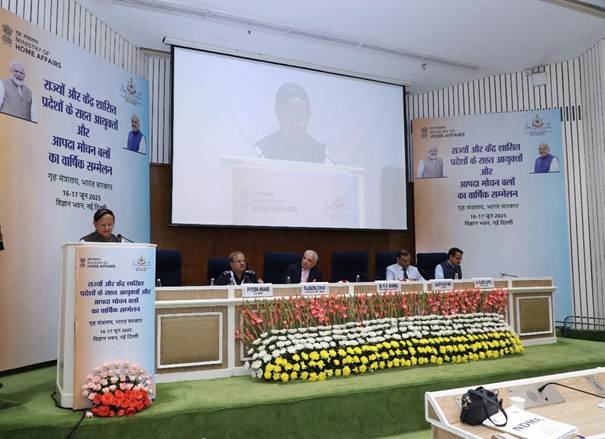
India’s evolving disaster landscape took center stage at the Annual Conference of Relief Commissioners and State Disaster Response Forces (SDRFs), held in New Delhi under the leadership of the Ministry of Home Affairs. The two-day event brought together over 1,000 delegates from across the country, including officials from state governments, central ministries, SDRFs, Civil Defence, Home Guards, and Fire Services.
Chairing the valedictory session, Principal Secretary to the Prime Minister P.K. Mishra emphasized the need for a fundamental shift in disaster risk management, acknowledging that hazards are increasingly interconnected and escalating faster than current response frameworks can adapt. He urged states to recalibrate their systems, institutions, and processes to address high-impact events such as lightning and drought, which are emerging as major threats.
Mishra outlined a strategic ten-point plan aimed at fortifying India’s disaster resilience. Key among his recommendations was a pivot from reactive relief to proactive preparedness and mitigation, calling for institutional memory to be captured and acted upon rather than forgotten. He cited India’s Disaster Risk Reduction (DRR) financing model as globally lauded but stressed the importance of proper utilization of Recovery and Mitigation Funds at the state level.
He also highlighted the urgency of improving response time, asserting that disaster preparedness must be measured not in hours but in minutes. With climate uncertainties rising, he called for states to invest in capacity augmentation, leverage data from the Gati Shakti program for better planning, and adopt local, low-cost interventions to address urban flooding and related challenges.
A strong emphasis was placed on community participation, with Mishra advocating for wider youth mobilization under the Prime Minister’s ‘My Bharat’ initiative and the inclusion of volunteer programs like Aapda Mitra in frontline disaster response.
Throughout the conference, sessions delved into early warning systems, urban flood management, post-disaster needs assessment, and the role of new technologies, reinforcing the government’s push for a future-ready, decentralized disaster management architecture aligned with India’s vast and diverse geography. The gathering concluded with a renewed commitment to embedding preparedness and inclusivity at the heart of India’s disaster governance strategy.