

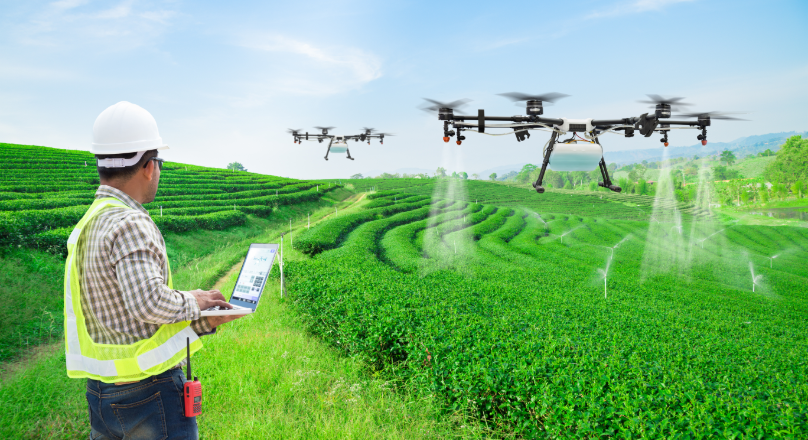
India’s agricultural sector is witnessing rapid integration of artificial intelligence and drone technologies aimed at enhancing crop productivity, market access and farmer income, particularly among smallholders and women-led groups. The Ministry of Agriculture and Farmers Welfare has unveiled a suite of initiatives designed to streamline farming operations, reduce losses and expand rural entrepreneurship through targeted digital interventions and incentive structures.
At the forefront is Kisan e-Mitra, an AI-powered, voice-based chatbot that currently handles over 20,000 farmer queries daily, mainly pertaining to the PM Kisan Samman Nidhi scheme. The multilingual platform supports 11 regional languages and has resolved more than 9.5 million queries to date, with plans to extend coverage to additional government programs.
To mitigate climate-related losses and optimize pest control, the government has implemented a National Pest Surveillance System based on AI and machine learning. Over 10,000 extension workers currently use the system to detect and report pest infestations. Farmers can submit photographs of pests to receive diagnostic and mitigation support. The platform supports 61 crop types and over 400 pest profiles, ensuring broad field-level applicability.
Satellite-based crop monitoring systems are also being deployed, powered by AI-driven analysis of geotagged field images. These systems aim to match crop phenology with weather patterns for improved resource planning and yield forecasting.
Under the Sub-Mission on Agricultural Mechanization (SMAM), a comprehensive subsidy regime has been designed to make drones more accessible to farmers, cooperatives and rural entrepreneurs. Institutions under ICAR, Krishi Vigyan Kendras, State Agricultural Universities, and other government-linked agencies receive 100 percent financial assistance for purchasing drones, up to ₹1 million per unit, for field demonstrations.
Farmers Producers Organizations are eligible for a 75 percent subsidy, while Rural Entrepreneurs and Cooperative Societies establishing Custom Hiring Centres (CHCs) can avail 40 percent financial support, capped at ₹400,000 per drone. Agriculture graduates managing CHCs may receive 50 percent subsidy, up to ₹500,000 per drone. For individual ownership, small and marginal farmers, Scheduled Caste/Scheduled Tribe farmers, women and farmers in Northeastern states are eligible for 50 percent subsidy up to ₹500,000, while other farmers qualify for 40 percent, with a ceiling of ₹400,000.
The government has also launched the Namo Drone Didi scheme as a Central Sector Scheme with an outlay of ₹1.26 billion over three years (2023–24 to 2025–26), targeting distribution of 15,000 drones to Women Self-Help Groups (SHGs). The scheme promotes drone-based farm services and supports SHGs with 80 percent subsidy on drone packages, up to ₹800,000. The remaining 20 percent is to be contributed by the SHGs, who may also access credit under the Agri Infrastructure Fund with 3 percent interest subvention.
In FY 2023–24, 1,094 drones were distributed to SHGs, including 500 under the Namo Drone Didi scheme, with Lead Fertilizer Companies using their internal resources. The remaining 14,500 drones are earmarked for distribution in the current and next fiscal years by the Department.
As of now, 2,622 drones have been distributed across India—2,122 through SMAM and 500 under Namo Drone Didi. Andhra Pradesh leads with 1,571 drones distributed, followed by Madhya Pradesh with 334, and Uttar Pradesh with 190. Other states like Karnataka (106), Telangana (72), and Maharashtra (55) have also received substantial allocations.
The deployment of AI tools and drones is reshaping India’s agricultural landscape, reinforcing digital inclusion, enhancing productivity, and creating new income streams for marginalized groups and women-led collectives. The government’s strategy reflects a shift toward precision farming and grassroots entrepreneurship, backed by targeted public investment and institutional coordination.