



Gulf War’s Devastating Fallout: Middle East on the Brink as Iran-US-Israel Conflict Threatens Global Stability
www.forevernews.in
New Delhi: The Middle East is witnessing one of its most dangerous geopolitical crises in recent decades, as the prolonged war involving Iran, Israel and the United States continues to destabilise the Gulf region, threaten international trade routes and inflict devastating consequences on civilian populations.
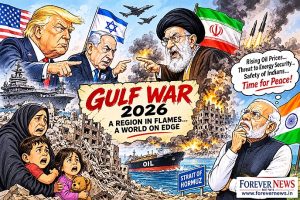
Gulf War’s Devastating Fallout: Middle East on the Brink as Iran-US-Israel Conflict Threatens Global Stability.
What began with US-Israeli military strikes against Iran on February 28, 2026, has evolved into a wider regional confrontation, drawing in strategic locations across the Gulf and raising fears of a prolonged conflict with consequences extending far beyond West Asia.
Despite intermittent diplomatic initiatives and ceasefire efforts, tensions remain dangerously high. The latest developments indicate that the prospect of a lasting peace remains uncertain, with military deployments increasing and maritime security deteriorating.
Military escalation threatens to engulf the Gulf
The situation has become increasingly volatile following renewed Iranian drone attacks and claims of strikes against American military installations in Bahrain. Bahrain’s air defence systems intercepted several aerial attacks on November 15, while Iran’s Revolutionary Guard claimed to have targeted a US radar facility.
The United States has further strengthened its military presence in the region. The arrival of the USS Theodore Roosevelt aircraft carrier strike group in the Middle East has taken American carrier deployments in the region to three, signalling Washington’s determination to maintain military pressure on Tehran.
Meanwhile, Iran has warned that it may strike first rather than wait for another American military offensive. Such statements underscore the fragile nature of the situation and the possibility that even a limited confrontation could trigger another round of large-scale hostilities.
The conflict has also expanded beyond the immediate Iran-Israel-US confrontation, with Houthi forces in Yemen threatening strategic targets in Saudi Arabia and adding another dimension to the regional security crisis.
Strait of Hormuz: The world’s energy lifeline under threat
One of the most alarming consequences of the conflict is the disruption of maritime traffic through the Strait of Hormuz, among the world’s most strategically important waterways.
Before the war, approximately one-fifth of global oil and liquefied natural gas shipments passed through this narrow passage connecting the Persian Gulf with international markets.
The latest shipping data indicate a dramatic deterioration. Only five commodity vessels crossed the Strait on Saturday, November 14, while no transits were registered on Sunday, November 15, according to ship-tracking data reported by Reuters.
This compares with more than 130 ships a day before the conflict.
Recent attacks on commercial vessels, including ships operated by Abu Dhabi National Oil Company, have heightened fears among shipping companies, insurers and energy traders. The US naval blockade of Iranian ports and Tehran’s insistence on conditions for restoring normal maritime traffic have further complicated the situation.
A prolonged disruption could push international crude oil prices higher, increase transportation and insurance costs and create fresh inflationary pressures across energy-dependent economies.
Civilian suffering and destruction on an alarming scale
Beyond military calculations and geopolitical rivalries lies the devastating human cost of the conflict.
Ordinary citizens are bearing the heaviest burden as military operations, infrastructure damage, economic disruption and insecurity undermine everyday life. Communities face displacement, interruptions to essential services, environmental contamination and mounting uncertainty about their future.
The destruction of infrastructure and attacks affecting energy installations, industrial facilities and transport networks threaten access to electricity, healthcare, clean water and other basic necessities.
The environmental consequences are equally concerning. Damage to industrial and energy facilities can release hazardous pollutants into the atmosphere and water systems, creating risks that may persist long after military operations cease.
The war has also intensified existing economic and environmental vulnerabilities in Iran and neighbouring countries, making recovery increasingly difficult for already stressed communities.
India’s economic and strategic interests at stake
For India, the Gulf conflict is not a distant geopolitical development. It has direct implications for energy security, trade, inflation, employment and the welfare of millions of Indians living and working across West Asia.
India depends substantially on imported crude oil and maintains extensive commercial and strategic relationships with Gulf nations. Any sustained disruption in oil supplies could increase India’s import bill, widen pressure on the current account and complicate inflation management.
Higher crude prices could translate into increased transportation costs, expensive logistics, pressure on manufacturing and a potential rise in the prices of essential commodities.
The security of Indian nationals in the region is another major concern. Millions of Indians live and work across Gulf countries, contributing significantly to the Indian economy through remittances. Any further deterioration in regional security could expose expatriate communities to uncertainty and disruption.
New Delhi must therefore maintain a careful diplomatic balance, safeguard its citizens and work with regional and international partners to protect maritime trade and energy supplies.
Diplomacy remains the only sustainable solution
The continuing confrontation also raises fundamental questions about the effectiveness of military solutions to complex geopolitical disputes.
The United States has maintained that its military campaign is intended to neutralise Iranian military and nuclear-related threats. Iran, meanwhile, has resisted American pressure and demanded an end to hostilities, the lifting of restrictions and broader guarantees.
Recent diplomatic efforts have struggled to produce a durable settlement. Statements suggesting that the war is militarily over have not translated into normalisation on the ground, with the naval blockade, military deployments and fresh security incidents continuing.
The international community cannot afford to treat this conflict as another regional power struggle. Its implications extend to global energy markets, food and commodity prices, international shipping, financial stability and humanitarian security.
The United Nations and major global powers must intensify diplomatic engagement to secure a sustainable ceasefire, protect civilian populations, restore freedom of navigation and establish a credible framework for negotiations.
The price of war will be paid by generations
The Gulf crisis is a stark reminder that modern warfare does not remain confined to battlefields. Its consequences travel through oil tankers, shipping lanes, financial markets, supply chains and the homes of ordinary people.
Military victories, strategic posturing and political declarations cannot compensate for destroyed livelihoods, lost lives, environmental damage and the erosion of regional stability.
The longer the confrontation continues, the greater the danger of an irreversible humanitarian and economic crisis.
The world needs de-escalation, not another escalation; dialogue, not destruction; and diplomacy, not a wider war. The future of the Gulf, and to a considerable extent the stability of the global economy, may depend on how quickly the principal parties recognise that there can be no lasting victory in a war that leaves an entire region devastated.
