



Is AI Really Taking Away Our Jobs? A Retrospection on the Future of Work
Artificial intelligence is not merely replacing workers; it is changing the economics of employment, the value of human skills and the very definition of productivity. The real question is whether society can create enough new opportunities for those whose jobs are being transformed.
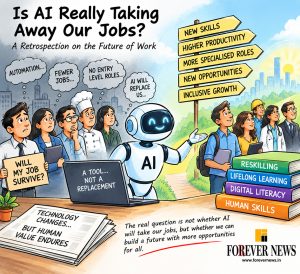
Is AI Really Taking Away Our Jobs? A Retrospection on the Future of Work.
The fear that technology will take away jobs is as old as industrialisation itself. When machines entered factories, workers feared losing their livelihoods. When computers arrived in offices, many worried that clerical jobs would disappear. The internet transformed banking, retail, travel and communications, while automation changed the way manufacturing operated.
Today, artificial intelligence has brought that familiar anxiety back with renewed intensity. But this time, the disruption is different. AI is no longer confined to factory floors or repetitive manual work. It can draft reports, analyse financial statements, write computer code, generate advertisements, answer customer queries and perform tasks once considered the exclusive domain of educated professionals.
The question confronting employees, employers and governments is straightforward: Is AI genuinely taking away jobs, or is it creating a new world of work in which some skills become obsolete while others become more valuable?
From job replacement to job transformation
The honest answer is that both are happening.
AI can automate routine activities, reduce the time required to complete assignments and enable companies to operate with smaller teams. Customer support, data entry, basic accounting, transaction processing, content production and certain software development tasks are particularly exposed.
For businesses, the attraction is understandable. A task that once required several employees working over many hours may now be completed more quickly with AI assistance and human supervision. Lower costs, faster delivery and improved productivity can strengthen competitiveness.
However, when productivity improves, the consequences for employment depend on what the business does next. A company may reduce its workforce, retain the same employees and increase output, or expand into new markets and create different jobs.
The technology itself does not determine the final outcome. Management decisions, consumer demand, investment, regulation and the availability of new opportunities all matter.
The International Labour Organization’s June 2026 review of emerging evidence found that large-scale job displacement from generative AI remained limited in the studies examined, even as work processes and employment opportunities began changing. It also highlighted concerns about inequality and fewer opportunities for younger workers. This suggests that the transition deserves attention without assuming that every exposed occupation will disappear.
India’s employment challenge
For India, the stakes are particularly high.
The country has built a significant services economy around information technology, business process outsourcing, banking support, customer service and other knowledge-based activities. These industries have generated employment for millions of professionals and helped India establish a strong position in the global economy.
AI presents a challenge to parts of this model. Tasks previously performed by large teams can increasingly be automated or handled by smaller teams equipped with sophisticated tools. International clients may continue to seek Indian expertise but demand greater productivity, specialised knowledge and quicker turnaround times rather than simply larger workforces.
A Reuters report in May 2026 described multinational companies operating in India pursuing growth with more cautious hiring and greater reliance on automation and specialised skills. This is an important signal for an economy whose employment aspirations depend heavily on expanding services and providing opportunities to young people.
The challenge is not limited to technology companies. Banks, insurance companies, media organisations, advertising agencies, educational institutions and corporate offices are also exploring AI-driven efficiencies.
For a country with a large and aspiring workforce, the central concern is whether emerging jobs can grow quickly enough to absorb workers displaced from traditional roles.
The entry-level job dilemma
Perhaps the most overlooked consequence of AI is its potential impact on the first rung of the employment ladder.
Entry-level jobs have traditionally provided young people with opportunities to learn, make mistakes, acquire professional discipline and develop practical experience. Junior analysts prepared reports, trainees checked data, young journalists researched stories, and new software developers handled basic coding assignments.
If AI performs many of these initial tasks, companies may require fewer beginners while expecting new recruits to possess more advanced skills from the outset.
This creates a paradox: employers want experienced, AI-proficient workers, but young people need entry-level opportunities to acquire that experience.
The World Economic Forum’s Future of Jobs Report 2025 identified both sides of the transition. Employers anticipated investment in reskilling and AI-related capabilities, while a substantial share also expected workforce reductions where AI could replicate existing work.
India must therefore ensure that AI adoption does not unintentionally close the doors through which its next generation of professionals enters the workforce.
The jobs that AI cannot easily replace
While AI can process information at extraordinary speed, professional work involves more than processing information.
Judgement, accountability, empathy, negotiation, leadership, ethical decision-making and an understanding of local circumstances remain important human contributions. A doctor must consider a patient’s circumstances, a teacher must understand a student’s difficulties, and a journalist must assess the credibility and public significance of information.
AI can assist each of these professionals, but assistance is not automatically equivalent to responsibility.
The same distinction applies to banking, law, public administration and business management. An AI-generated recommendation may be useful, but someone must verify the facts, assess the risks and accept responsibility for the decision.
This does not mean that these professions are immune to disruption. Their tasks, staffing requirements and skill expectations may change substantially. The advantage will increasingly belong to people who combine professional expertise with the ability to use AI intelligently.
A new opportunity for entrepreneurs and small businesses
There is another side to the debate that deserves equal attention.
AI tools can give small businesses access to capabilities that were once expensive or available only to large organisations. A small publisher can accelerate research and editing. A local retailer can improve customer communication. A start-up can analyse markets, prepare presentations and automate routine administrative work without immediately building a large team.
For India’s millions of small enterprises, this could improve productivity and create opportunities for expansion.
Yet the benefits are not automatic. Businesses must invest in training, protect confidential information, verify AI-generated output and avoid allowing efficiency gains to become a substitute for every form of human expertise.
The policy challenge is to encourage innovation while ensuring that the benefits of technological progress are not concentrated exclusively among a small group of companies and highly skilled workers.
What should employees and governments do?
The answer cannot simply be to resist AI or to assume that every worker can become a software engineer.
Employees should develop practical AI literacy alongside their existing professional skills. Accountants can learn to use AI-assisted analysis; journalists can improve research and verification workflows; bankers can combine digital tools with risk assessment and customer understanding. The objective should be to become more capable in one’s chosen profession.
Employers, meanwhile, must recognise that a trained workforce is an asset. Reskilling existing employees, redesigning roles and creating pathways into emerging occupations can reduce the human cost of transition.
Governments and educational institutions must strengthen vocational training, apprenticeships, digital access and industry-linked education. They should also monitor employment trends, particularly among young workers, and consider appropriate support for workers facing displacement.
Most importantly, productivity gains must translate into broader economic benefits. If companies produce more with fewer employees but fail to generate sufficient demand, investment or alternative employment, the economy may face a serious imbalance between rising productive capacity and household purchasing power.
The real retrospective: technology changes, but responsibility remains human
History teaches us that technological progress can eliminate particular occupations while creating new industries and opportunities. But history does not guarantee that every displaced worker will find a suitable new job, that every region will benefit equally or that the transition will occur without hardship.
AI may not eliminate work itself. It may, however, eliminate some jobs, reduce hiring in certain occupations, alter salary structures and increase the premium placed on specialised skills. For those affected, the distinction between a job disappearing and a job changing can be of little comfort unless a viable alternative exists.
The debate must therefore move beyond two simplistic positions: that AI will destroy employment on an unprecedented scale, or that technological innovation will automatically create enough jobs to compensate for every loss.
Neither outcome should be taken for granted.
The future will depend on how businesses deploy AI, how educational systems prepare workers, how governments respond to disruption and how the gains from higher productivity are distributed.
AI may increasingly perform the tasks that people once did, but society must still decide what happens to the people whose livelihoods depend on those tasks.
The real test of progress will not be how many jobs machines can replace or how quickly companies can reduce costs. It will be whether India can use artificial intelligence to build a more productive, competitive and inclusive economy—one in which technology expands human potential rather than leaving human beings behind.
For Forever News, the message is clear: AI is changing the world of work, but the future of employment remains a question of human choices, economic policy and social responsibility.
