



Uncertain Times Ahead: A World and Society Under Strain
Forever News
There is a growing uneasiness across societies today that cannot be explained by any single economic indicator, political event or geopolitical conflict. The world is entering a period in which uncertainty itself has become a defining feature of public life.
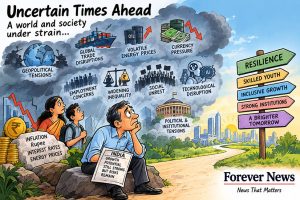
Uncertain Times Ahead: A World and Society Under Strain.
For India, the challenge is not that the economy is collapsing. Far from it. The country continues to demonstrate resilience, strong domestic demand and significant economic potential. But beneath the headline numbers lies a more complicated reality: geopolitical tensions, volatile energy prices, currency pressures, employment concerns, widening expectations and increasing social polarisation are creating an environment in which economic progress and social anxiety can coexist.
The coming months therefore demand not complacency, but preparedness.
The global economic environment remains fragile. The International Monetary Fund has warned that renewed conflict, geopolitical fragmentation, trade tensions and financial-market repricing could weaken global growth and destabilise markets. Its latest outlook projects global growth at around 3 per cent in 2026, while cautioning that the risks remain significant.
For India, one immediate vulnerability is the external environment. Crude oil prices, global interest rates and capital flows have a direct bearing on inflation, the rupee and the cost of imports. The Finance Ministry’s latest economic review has itself flagged geopolitical tensions, elevated crude prices, tighter global financial conditions and possible weather disruptions as risks to India’s near-term economic stability.
The rupee’s recent weakness is another reminder that no large economy operates in isolation. The currency has faced pressure from capital outflows and global financial conditions, even as India’s foreign exchange reserves provide an important cushion.
Yet economic uncertainty is only one part of the story.
The more consequential question is whether economic stress eventually becomes social stress.
India’s unemployment numbers have improved in recent months, with the unemployment rate falling to 5 per cent in August. But urban unemployment remained considerably higher at 6.8 per cent. For millions of young Indians, particularly those entering the workforce with rising educational and lifestyle expectations, the availability of secure and meaningful employment matters far more than aggregate GDP growth.
This is where the social contract becomes important.
A young population will tolerate temporary hardship if it believes that opportunity is expanding. But when aspirations rise faster than opportunities, frustration can become political, social and eventually disruptive.
Inequality adds another dimension. Economic growth can create enormous wealth while simultaneously producing a perception that its benefits are unevenly distributed. Recent research examining Indian villages has found a relationship between inequality and the probability of social unrest. The lesson is not that inequality automatically produces unrest, but that perceptions of unfairness can become a powerful source of social tension.
Technology is complicating the picture further.
Artificial intelligence promises productivity, new industries and enormous economic opportunities. But it is also forcing societies to confront an uncomfortable question: what happens when technology improves productivity faster than economies can create new forms of employment?
The answer will not simply be found in technology. It will depend on education, reskilling, social security and the ability of governments and businesses to prepare people for jobs that do not yet exist.
Meanwhile, political and institutional tensions are becoming increasingly visible. Recent protests in major Indian cities over electoral issues demonstrate how quickly questions surrounding institutions can become matters of mass mobilisation. Whatever one’s political position, the larger concern should be the preservation of public confidence in democratic institutions and processes.
A democracy cannot function indefinitely on distrust.
The danger in uncertain times is that every economic difficulty begins to acquire a political explanation, every political disagreement becomes a social confrontation, and every social-media controversy is amplified into a national crisis.
This is precisely why responsible leadership becomes indispensable.
Governments must communicate honestly about economic risks while protecting vulnerable sections of society. Businesses must continue investing and creating employment rather than becoming excessively defensive. Financial institutions must remain vigilant against fraud and excessive risk-taking. And citizens must learn to distinguish between genuine information and digitally amplified fear.
The media, too, has a particularly important responsibility.
In an age where sensationalism can generate clicks within seconds, journalism must resist the temptation to convert every uncertainty into a crisis. The public needs facts, context and perspective—not permanent alarm.
India has faced difficult periods before and has repeatedly demonstrated its ability to adapt. Its large domestic market, expanding digital economy, infrastructure investment, entrepreneurial energy and demographic advantages remain powerful strengths.
But strengths should never become excuses for complacency.
The road ahead may bring higher energy costs, volatile markets, changing employment patterns, geopolitical shocks, social tensions and political uncertainty. None of these necessarily points towards a crisis. But together they create an environment in which small mistakes can have larger consequences.
The answer is neither pessimism nor blind optimism.
It is resilience.
Families need stronger financial discipline. Businesses need prudent balance sheets and adaptable strategies. Young people need skills that remain relevant in a rapidly changing economy. Governments need fiscal and institutional credibility. And society needs greater tolerance for disagreement without allowing differences to become divisions.
The next few years may not be comfortable. They may be unpredictable.
But uncertainty does not have to become instability.
India’s real test will be whether it can convert uncertainty into preparedness, economic growth into broad-based opportunity, technological disruption into employment and political competition into stronger democratic institutions.
The future will not necessarily be determined by the shocks that come our way.
It will be determined by how prepared we are when they arrive.
