

Bank Strike Deferred at Last Minute: Banking Services Continue, But Five-Day Week Issue Remains Unresolved
New Delhi, September 28, 2026: Millions of bank customers heaved a sigh of relief on Monday after the United Forum of Bank Unions (UFBU) deferred its proposed three-day nationwide strike that was scheduled from September 28 to 30. The decision came after a late-night meeting between the UFBU and the Indian Banks’ Association (IBA) on Sunday, September 27.
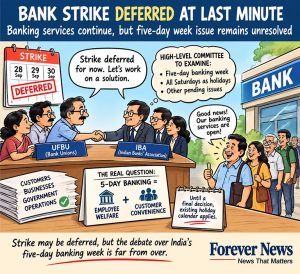
Bank Strike Deferred at Last Minute: Banking Services Continue, But Five-Day Week Issue Remains Unresolved.
The development means bank branches will function normally during the period originally earmarked for the strike, avoiding what could have become a prolonged disruption at a particularly sensitive point in the banking calendar. The proposed strike would have coincided with the September 30 half-yearly closing of banks and followed the weekend, potentially creating an extended disruption in branch-based banking services.
High-level committee to examine five-day banking
The immediate outcome of the late-night discussions is the decision to constitute a high-level committee comprising representatives of the IBA and UFBU.
The committee will examine the unions’ principal demand for a five-day banking week, including the proposal to declare the remaining working Saturdays as holidays. It is expected to consult stakeholders and examine possible alternatives before working towards a solution that takes into account the interests of employees as well as customers.
The UFBU has therefore deferred the strike and other planned agitation for the time being. However, the core issue has not been finally resolved.
Relief for customers and businesses
For customers, the immediate impact is straightforward: the three-day closure of bank branches that had been feared for September 28-30 will not take place.
The timing of the deferment is significant. September 30 marks the half-yearly closing of banks, when reconciliation, provisioning, treasury operations and other financial processes assume added importance. The Finance Ministry had earlier warned that a strike combined with the preceding weekend could effectively disrupt banking services for five consecutive days.
Businesses, government departments and individuals requiring branch-based services can consequently proceed with their banking activities without the disruption that had been anticipated.
The government had also taken precautionary measures ahead of the proposed strike. Public Sector Banks and Regional Rural Banks were directed to keep branches operational on Sunday, September 27, to reduce the inconvenience that could have resulted from the strike immediately following the weekend.
What was the dispute about?
The central issue behind the agitation has been the implementation of a five-day banking week.
Bank unions have maintained that the proposal for all Saturdays to be holidays was part of the understanding reached during the 12th Bipartite Settlement in March 2024, subject to government approval and the necessary regulatory clearances.
The government, however, has maintained that the five-day working week has not yet been finally approved and that the issue requires consideration of various stakeholders. This difference in interpretation has remained at the centre of the dispute.
Another issue raised by the unions was the Performance Linked Incentive (PLI) scheme. The government had already kept the PLI scheme in abeyance, thereby addressing one of the unions’ principal concerns, according to the Finance Ministry.
The next challenge: finding common ground
The deferment provides breathing space for both sides, but it also places responsibility on the newly proposed committee to produce tangible progress.
For bank employees, the five-day week is linked to working conditions and the restructuring of working hours. For customers, however, the question is whether fewer working days at branches can be accompanied by adequate service availability through digital banking, ATMs, customer service centres and other channels.
India’s banking system has undergone rapid digitalisation, with a large proportion of routine transactions already taking place through digital platforms. Yet branch services remain important for cash-intensive businesses, senior citizens, documentation, account-related matters, loan services and other transactions that require personal interaction.
Any decision on a five-day banking week will therefore have to balance employee expectations with customer convenience and operational requirements.
No immediate change in bank working pattern
The deferment does not mean that the five-day banking week has been implemented.
Until a final decision is taken and the necessary approvals are obtained, the existing system of bank holidays remains applicable. Customers should therefore continue to follow the officially notified bank holiday calendar rather than assume that all Saturdays have become holidays.
The late-night agreement has prevented an immediate confrontation, but the larger issue remains on the negotiating table.
From confrontation to dialogue
The latest development marks a shift from industrial action to structured negotiations.
The proposed strike had generated concern among customers and businesses because of its timing. With the action deferred, the immediate disruption has been avoided. The focus now moves to whether the IBA-UFBU committee can bridge the differences over the five-day banking week.
For the banking industry, the coming discussions could be significant. A final agreement would have implications not only for employees and managements but also for branch operations, customer service, working-hour arrangements and the broader functioning of India’s banking system.
For now, customers can expect normal banking operations, while the unions and the banking management return to the negotiating table.
The strike may have been deferred, but the debate over the future working pattern of India’s banks is far from over.